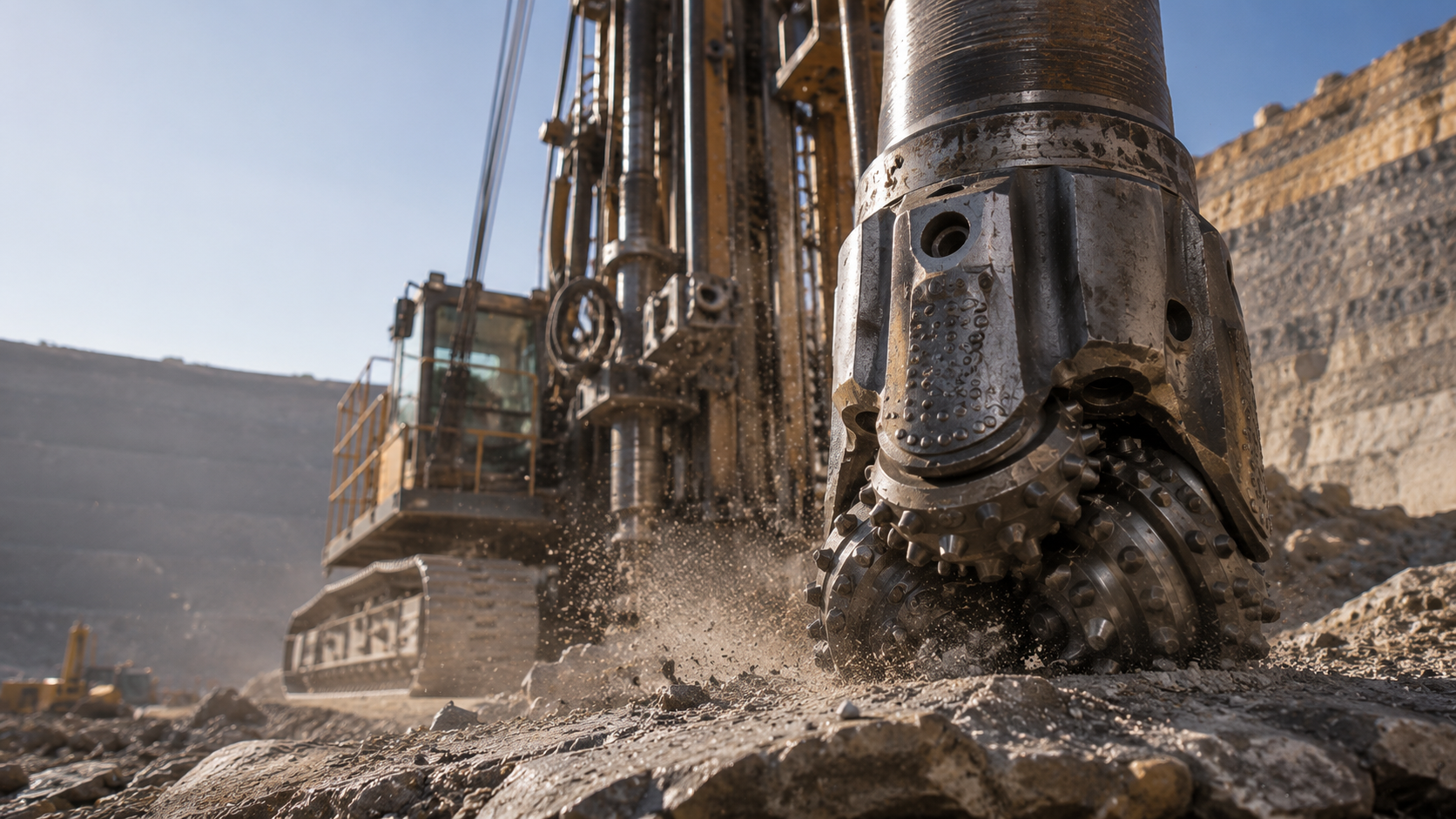
Rate of Penetration (ROP) is one of the most important performance indicators in rotary drilling.
A higher ROP can reduce drilling time, lower rig operating costs, improve drilling efficiency, and potentially reduce the total cost per foot or meter.
However, increasing ROP is not as simple as increasing Weight on Bit (WOB) or rotating the drill bit faster.
If the tricone drill bit is poorly matched to the formation, increasing WOB or RPM may actually accelerate wear, increase vibration, damage the bearing system, and reduce overall drilling performance.
The most effective approach is to optimize the entire drilling system:
Formation + Bit Design + WOB + RPM + Hydraulics + Bottom-Hole Cleaning + Drilling Stability
In this guide, we explain how the right tricone drill bit can help improve ROP and how drilling contractors can optimize bit selection and operating parameters without sacrificing bit life.
What Is ROP in Rotary Drilling?
Rate of Penetration, commonly abbreviated as ROP, refers to how quickly the drill bit advances through the formation.
It is commonly expressed as:
- Feet per hour (ft/h)
- Meters per hour (m/h)
For example, if a drill bit advances 60 meters in 10 hours:
ROP = 6 m/h
Although ROP is an important performance indicator, it should not be evaluated alone.
A drill bit that produces very high initial ROP but fails prematurely may not be the most economical option.
A better evaluation considers:
ROP + Bit Life + Footage + Trip Time + Drilling Cost
This is why professional drilling optimization focuses on sustainable ROP rather than simply maximizing instantaneous penetration.
Why Does ROP Matter?
Higher ROP can provide several operational benefits.
Reduced Drilling Time
If the same formation can be drilled faster, the rig spends less time making hole.
This can be particularly important for deep drilling projects where rig operating costs are significant.
Lower Rig Operating Cost
Every additional hour of drilling consumes:
- Fuel or power
- Labor
- Drilling fluid
- Equipment operating time
- Maintenance resources
Improving ROP can therefore contribute directly to lower drilling costs.
Fewer Hours on Bottom
Efficient rock breaking means the drill bit can reach the target depth in less time.
However, high ROP should not come at the expense of excessive bit wear.
Potentially Lower Cost per Foot
The ultimate objective is often not:
“How fast can I drill?”
but:
“How economically can I drill the required footage?”
This distinction is critical when comparing different tricone drill bit designs.
The Relationship Between Tricone Bit Selection and ROP
The drill bit is the point where mechanical energy is transferred directly into the formation.
If the cutting structure is properly matched to the rock, a greater proportion of the applied energy can be used for productive rock breaking.
If the bit is poorly matched, energy can instead be consumed by:
- Excessive friction
- Vibration
- Bit bounce
- Cutter wear
- Cone slippage
- Formation balling
- Inefficient cutting
This means that bit selection is one of the first places to look when ROP is consistently below expectations.
Match the Tricone Bit to the Formation
The first rule of ROP optimization is simple:
Use a bit designed for the formation you are actually drilling.
Formation characteristics that should be evaluated include:
- Rock hardness
- Compressive strength
- Abrasiveness
- Fracturing
- Interbedding
- Plasticity
- Formation homogeneity
- Expected drilling depth
A bit designed for soft shale may perform poorly in hard limestone.
A bit designed for extremely hard rock may also drill inefficiently in a soft formation because its cutting structure may be too conservative.
The objective is to achieve the correct balance between aggressiveness and durability.
Choose the Correct Cutting Structure
The cutting structure has a direct influence on how efficiently the tricone bit interacts with the formation.
For tricone bits, this generally means selecting between:
- Milled tooth designs
- TCI designs
and then selecting the appropriate tooth or insert geometry.
Milled Tooth Tricone Bits
Milled tooth bits can provide aggressive cutting action in suitable soft and medium formations.
Their performance depends heavily on:
- Tooth height
- Tooth spacing
- Tooth geometry
- Cone offset
- Formation hardness
- Formation abrasiveness
In a soft formation, an aggressive milled tooth design can provide excellent penetration.
However, excessive tooth wear can quickly reduce performance in abrasive rock.
TCI Tricone Bits
TCI bits use tungsten carbide inserts mounted into the cones.
They are widely used for medium, hard, and abrasive formations.
The insert design can be optimized through:
- Insert shape
- Insert diameter
- Insert exposure
- Insert spacing
- Carbide grade
- Insert placement
A properly selected TCI cutting structure can improve rock-breaking efficiency while maintaining acceptable wear resistance.
Do Not Automatically Choose the Most Aggressive Bit
Aggressive does not always mean faster.
If the cutting structure is too aggressive for the formation, the bit may experience:
- Excessive vibration
- Insert breakage
- Tooth damage
- Cone damage
- Bearing stress
- Uneven wear
The result can be a lower average ROP over the complete bit run.
For example:
A highly aggressive bit may initially drill at 12 m/h.
But if severe vibration develops and the bit must be pulled after a short interval, the overall drilling efficiency may be worse than a more stable bit drilling at 9 m/h for a much longer interval.
Therefore, the target should be:
Maximum sustainable ROP
rather than:
Maximum instantaneous ROP
How WOB Affects Tricone Bit ROP
WOB, or Weight on Bit, is one of the most important drilling parameters affecting ROP.
In general, increasing WOB can increase the force applied to the cutting elements and improve rock penetration.
However, the relationship is not unlimited.
At some point, additional WOB may produce diminishing returns.
Excessive WOB can cause:
- Insert breakage
- Tooth wear
- Cone damage
- Bearing overload
- Increased vibration
- Reduced drilling stability
The optimum WOB therefore depends on:
- Formation strength
- Bit diameter
- Bit design
- Cutting structure
- RPM
- Drilling system
- Hydraulic conditions
The objective is to find the operating range where additional WOB continues to produce useful penetration without creating disproportionate wear.
How RPM Affects ROP
RPM controls how frequently the cutting structure interacts with the formation.
Increasing RPM can increase the rate of cutting interactions and may improve ROP in suitable conditions.
However, excessive RPM can also increase:
- Cutter wear
- Vibration
- Heat generation
- Bearing stress
- Cone wear
- Drilling instability
The optimum RPM therefore depends on both the formation and the tricone bit design.
A soft formation with an aggressive cutting structure may tolerate a different RPM range from a hard, abrasive formation with a heavily reinforced TCI bit.
WOB and RPM Must Be Optimized Together
One of the most common mistakes is adjusting WOB and RPM independently.
They interact with each other.
For example:
High WOB + Low RPM
may create high loading on individual cutting elements.
Low WOB + High RPM
may produce insufficient penetration while increasing sliding and wear.
High WOB + High RPM
may generate excessive mechanical stress and vibration.
The optimal combination depends on the formation and bit design.
A useful approach is to monitor:
- ROP
- Torque
- Vibration
- WOB
- RPM
- Bit hours
- Formation changes
and adjust the drilling parameters based on actual downhole behavior.
Hydraulics and Bottom-Hole Cleaning
A powerful drill bit cannot perform efficiently if the bottom of the hole is not cleaned properly.
As the tricone bit breaks the formation, rock cuttings must be transported away from the bit.
If cuttings accumulate around the cutting structure, they can interfere with rock-bit contact.
This can lead to:
- Reduced ROP
- Regrinding of cuttings
- Increased torque
- Bit balling
- Higher energy consumption
- Increased wear
Hydraulic performance should therefore be considered part of ROP optimization.
Nozzle Configuration Matters
The nozzle system affects how drilling fluid reaches the bottom of the hole.
Important factors include:
- Nozzle size
- Nozzle placement
- Flow rate
- Pressure
- Jet velocity
- Formation characteristics
A suitable hydraulic configuration helps remove cuttings efficiently and keep the cutting structure exposed to fresh formation.
This is particularly important when drilling:
- Soft shale
- Sticky clay
- Plastic formations
- High-cuttings-load intervals
Prevent Bit Balling
Bit balling occurs when formation material accumulates around the cutting structure.
It is particularly common in soft, sticky, or plastic formations.
When balling occurs, the effective cutting structure becomes partially blocked.
The bit may continue rotating, but the cutting elements are no longer interacting efficiently with fresh formation.
Symptoms can include:
- Sudden ROP reduction
- Increasing torque
- Increasing pump pressure
- Poor cuttings return
- Unstable drilling
To reduce bit balling risk:
- Use an appropriate cutting structure
- Optimize hydraulics
- Maintain effective flow
- Select suitable nozzle configuration
- Avoid operating conditions that encourage excessive accumulation
Formation Changes Can Cause Sudden ROP Loss
A drilling interval may not be uniform.
For example:
Shale → Limestone → Sandstone → Shale
A tricone bit optimized for one formation may not perform equally well when the formation changes.
Sudden ROP changes can therefore be a useful indication that formation properties have changed.
When ROP decreases unexpectedly, check whether there has been a change in:
- Rock hardness
- Abrasiveness
- Lithology
- Fracturing
- Interbedding
Before changing WOB or RPM aggressively, confirm whether the formation itself has changed.
Vibration Is a Major Enemy of ROP
Excessive vibration can consume drilling energy without contributing efficiently to rock breaking.
Common forms include:
- Axial vibration
- Lateral vibration
- Torsional vibration
- Bit bounce
Vibration can also accelerate:
- Insert damage
- Bearing wear
- Cone damage
- Gauge wear
- BHA fatigue
If ROP is poor and vibration is high, simply increasing WOB may make the problem worse.
A better strategy is to identify the source of instability and optimize the bit and drilling parameters accordingly.
How Bit Design Influences Vibration
Tricone bit design can influence drilling stability through:
- Cone geometry
- Tooth or insert placement
- Cone offset
- Cutting structure aggressiveness
- Gauge protection
- Bit profile
A bit that is too aggressive for the formation may generate unstable interaction.
A properly balanced design can provide more consistent rock breaking and improved drilling stability.
Optimize for Mechanical Specific Energy
Another useful concept for drilling optimization is Mechanical Specific Energy (MSE).
MSE represents the mechanical energy required to remove a given volume of rock.
If MSE becomes unnecessarily high, it may indicate that drilling energy is not being used efficiently.
Possible causes include:
- Poor bit selection
- Dull cutting elements
- Excessive vibration
- Inefficient hydraulics
- Incorrect WOB
- Incorrect RPM
- Formation changes
Monitoring MSE can therefore help engineers identify opportunities to improve drilling efficiency.
The goal is not simply to maximize WOB or RPM.
The goal is to use mechanical energy efficiently.
Use Dull Bit Grading to Improve the Next Run
One of the most valuable sources of information is the condition of the bit after it comes out of the hole.
Inspect:
- Teeth or inserts
- Cone condition
- Bearings
- Seals
- Gauge
- Shirttail
- Nozzles
- Bit body
A dull bit tells you how the previous drilling strategy performed.
For example:
Severe insert wear + good ROP
may indicate that the bit was productive but could benefit from improved wear resistance.
Low ROP + relatively low wear
may indicate that the cutting structure was too conservative.
Bearing failure + good cutting-element condition
may indicate that mechanical loading or operating conditions need investigation.
Gauge wear + acceptable cutting-element condition
may indicate that additional gauge protection is required.
The next bit should be selected using this information.
How to Increase ROP Without Destroying Bit Life
The ideal drilling strategy balances two competing objectives:
Penetration rate
and
Bit durability
A useful optimization process is:
Step 1 — Establish a Baseline
Record:
- Current ROP
- Bit type
- IADC classification
- Bit size
- WOB
- RPM
- Torque
- Bit hours
- Drilled footage
Step 2 — Analyze Formation
Determine:
- Hardness
- Abrasiveness
- Lithology
- Fracturing
- Formation variability
Step 3 — Evaluate the Current Bit
Inspect the dull condition and identify the dominant wear mechanism.
Step 4 — Adjust Bit Design
Consider:
- Cutting structure
- Insert geometry
- Tooth design
- Gauge protection
- Bearing configuration
- Hydraulic design
Step 5 — Optimize WOB and RPM
Adjust operating parameters gradually rather than making large changes.
Step 6 — Monitor ROP and Stability
Track:
- ROP
- Torque
- Vibration
- Pump pressure
- Cuttings return
Step 7 — Evaluate Total Run Performance
Do not judge the bit based only on initial ROP.
Evaluate:
Total footage + average ROP + bit hours + dull condition + trip time
Example: Why a Faster Bit May Not Be the Better Bit
Consider two drilling bits.
Bit A
- ROP: 10 m/h
- Bit life: 80 hours
- Footage: 800 m
Bit B
- ROP: 13 m/h
- Bit life: 40 hours
- Footage: 520 m
At first glance, Bit B appears superior because it has a higher ROP.
But Bit A drills significantly more footage per run.
If changing the bit requires a long trip, Bit A may produce lower overall drilling cost despite its lower instantaneous ROP.
This is why professional drilling optimization should focus on average performance across the complete drilling cycle.
The Role of Bit Diameter
Bit diameter also affects ROP and drilling behavior.
Larger drill bits generally require different combinations of:
- WOB
- RPM
- Hydraulic flow
- Torque
- Cutting structure
A drilling parameter that works well for a 6-inch bit may not be appropriate for a 12 1/4-inch tricone bit.
Therefore, ROP optimization should always consider the complete bit size and drilling system.
How to Improve ROP in Hard Rock
Hard-rock drilling requires a different strategy from soft-formation drilling.
Focus on:
- Correct TCI bit selection
- Strong insert design
- Appropriate insert spacing
- Durable gauge protection
- Stable WOB
- Controlled RPM
- Effective cooling and cleaning
- Vibration management
Increasing WOB aggressively in hard rock can create excessive insert loading without producing proportional ROP improvement.
The objective is controlled rock crushing and efficient energy transfer.
How to Improve ROP in Soft Rock
Soft formations often require a more aggressive cutting structure.
Potential improvements include:
- More aggressive tooth or insert geometry
- Appropriate cone offset
- Effective hydraulics
- Improved bottom-hole cleaning
- Proper RPM
- Controlled WOB
However, soft formations can create another problem:
Bit balling.
If the formation is sticky, hydraulic cleaning may be just as important as cutting structure aggressiveness.
How to Improve ROP in Abrasive Formation
Abrasive formations create a different optimization challenge.
The priority becomes maintaining cutting efficiency while controlling wear.
Consider:
- Wear-resistant carbide inserts
- Strong gauge protection
- Appropriate insert geometry
- Controlled RPM
- Effective hydraulics
- Proper drilling parameters
A bit that produces excellent ROP for the first 50 meters but rapidly loses its cutting structure may not be the most economical solution.
The target should be stable ROP throughout the useful bit life.
10 Practical Ways to Improve Tricone Bit ROP
Based on the principles above, drilling contractors can review these ten areas:
1. Match the Bit to the Formation
Do not select a bit based only on diameter or purchase price.
2. Choose the Correct IADC Classification
Use formation characteristics and previous bit performance to determine the appropriate classification.
3. Select the Right Cutting Structure
Balance aggressiveness with durability.
4. Optimize WOB
Increase WOB only when additional loading produces useful penetration.
5. Optimize RPM
Avoid unnecessarily high rotational speed that creates excessive wear.
6. Improve Bottom-Hole Cleaning
Ensure cuttings are effectively removed.
7. Control Vibration
Stable drilling usually produces more efficient energy transfer.
8. Monitor Torque
Unexpected torque changes can indicate formation changes, balling, or drilling instability.
9. Analyze the Dull Bit
Use the previous bit’s condition to improve the next bit selection.
10. Measure Cost per Foot
Evaluate drilling economics rather than ROP alone.
ROP Optimization Checklist
Before starting a new drilling interval, review:
Formation
- What rock type will be drilled?
- How hard is it?
- How abrasive is it?
- Is it fractured?
- Is it interbedded?
Bit
- Is the IADC classification appropriate?
- Is the cutting structure suitable?
- Is the gauge adequately protected?
- Is the bearing system appropriate?
Parameters
- What WOB will be used?
- What RPM will be used?
- What torque is expected?
Hydraulics
- Is flow sufficient?
- Is nozzle configuration appropriate?
- Is bottom-hole cleaning effective?
Performance
- What was the previous ROP?
- How many meters did the previous bit drill?
- Why was the previous bit pulled?
- What did the dull condition show?
This checklist can help prevent the common mistake of treating ROP as a single-parameter problem.
ROP Is a System Optimization Problem
Improving ROP is not simply about finding a more aggressive drill bit.
It requires coordination between:
Bit Design
Formation
WOB
RPM
Hydraulics
BHA
Drilling Stability
Bit Wear
When these factors are properly matched, the drill bit can convert a greater proportion of available mechanical energy into productive rock breaking.
That is the foundation of efficient drilling.
Frequently Asked Questions
What is a good ROP for a tricone drill bit?
There is no universal target ROP. A reasonable ROP depends on bit diameter, formation hardness, abrasiveness, drilling equipment, WOB, RPM, hydraulics, and application. The more useful benchmark is performance compared with previous runs under similar conditions.
How can I increase ROP with a tricone bit?
Start by confirming that the bit is properly matched to the formation. Then optimize WOB, RPM, hydraulic cleaning, and vibration. Review the previous bit’s dull condition before making major changes.
Does increasing WOB always increase ROP?
No. ROP may increase with WOB within a useful operating range, but excessive WOB can cause diminishing returns, vibration, insert damage, and bearing stress.
Does increasing RPM increase drilling speed?
Increasing RPM can increase ROP in suitable conditions, but excessive RPM can increase wear and vibration. The optimum RPM depends on the bit and formation.
What causes low ROP when the bit still looks new?
Possible causes include an overly conservative cutting structure, insufficient WOB, unsuitable RPM, poor hydraulics, inadequate bottom-hole cleaning, formation changes, or vibration.
Can a different IADC code improve ROP?
It can, if the previous bit was poorly matched to the formation. However, changing the IADC code alone does not guarantee higher ROP. Cutting structure, insert geometry, bearing design, hydraulics, and drilling parameters must also be considered.
How does bit balling affect ROP?
Bit balling can severely reduce effective cutting action because formation material accumulates around the cutting structure. This can cause lower ROP, higher torque, poor cleaning, and inefficient drilling.
Is the highest ROP always the best drilling result?
No. The best result is usually the best combination of ROP, footage, bit life, trip time, and total drilling cost.
Final Thoughts
Improving ROP with a tricone drill bit starts with selecting the right bit for the formation.
But bit selection is only the beginning.
The best drilling performance comes from optimizing the entire system:
Formation → Bit Design → WOB → RPM → Hydraulics → Stability → Dull Analysis
A highly aggressive bit can produce excellent initial penetration but fail prematurely.
A durable bit can provide long footage but drill too slowly.
The ideal solution is the configuration that provides stable, sustainable ROP while maintaining acceptable bit life and drilling economics.
For drilling contractors, mining companies, water well contractors, geothermal drilling companies, and other professional drilling operations, actual field data is one of the most valuable tools for improving bit performance.
At Lilin Bit, we manufacture and supply tricone drill bits and PDC drill bits for different formations and drilling applications. By analyzing formation characteristics, drilling parameters, previous bit performance, and dull conditions, we can help customers select and optimize a drill bit configuration based on their actual drilling requirements.
Looking to improve ROP on your next drilling project? Send us your bit size, formation type, current IADC code, WOB, RPM, previous ROP, drilled footage, and dull bit condition. Our team can help evaluate the bit design and identify opportunities for better drilling performance.