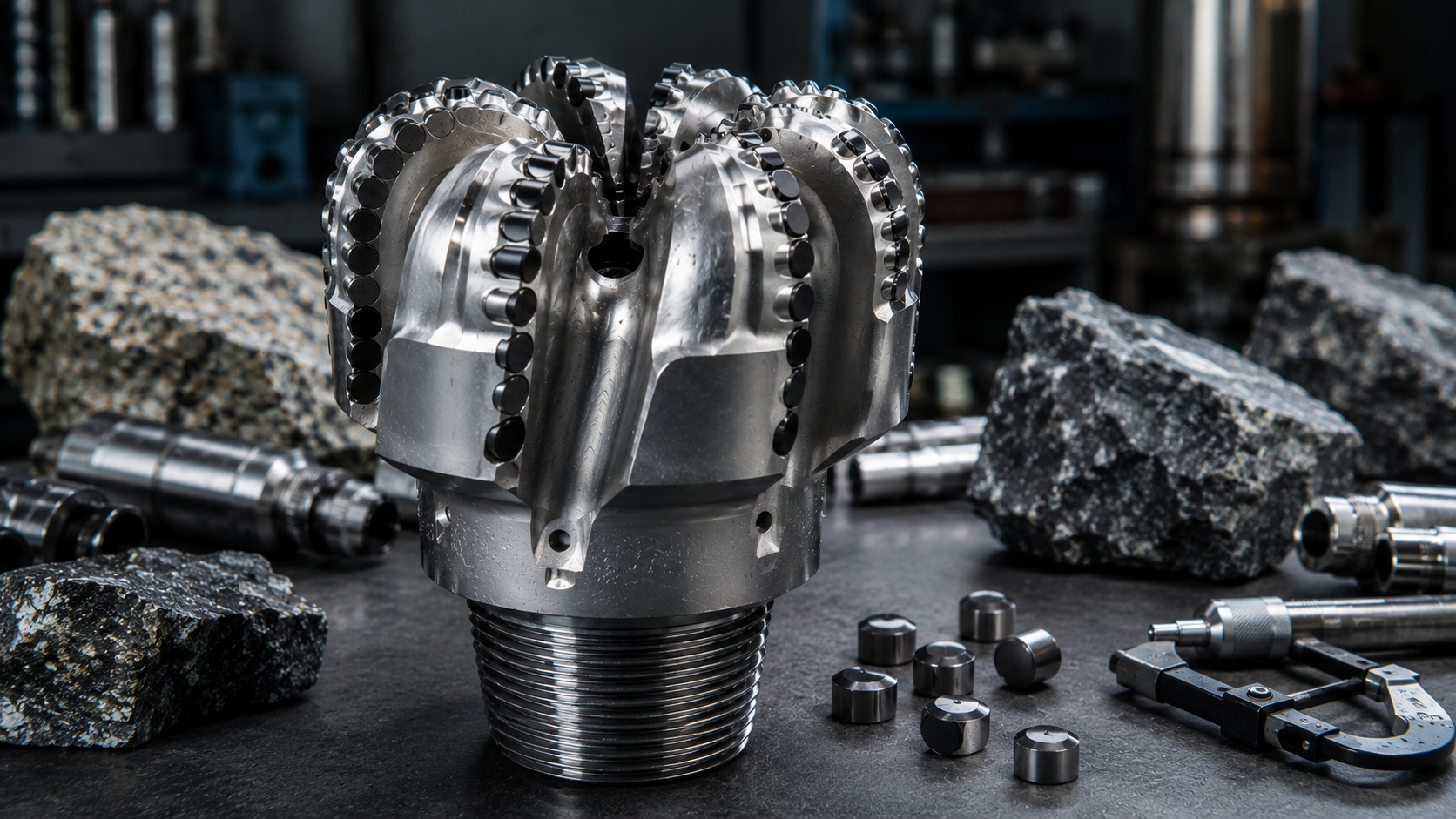
Choosing the right PDC Bit is not simply a matter of selecting a bit with more cutters or a higher purchase price. PDC drilling performance depends on how well the bit design matches the formation, drilling system, operating parameters and expected wear mechanism.
For drilling contractors, engineers and procurement teams, one of the most important questions is how to select a PDC bit based on real drilling conditions rather than relying on a generic model description. Another common question is how IADC relates to PDC bit selection and quality evaluation.
The answer requires an important distinction: the IADC system used for roller-cone bit classification should not be directly applied to PDC bit design as though both systems use the same three-digit code. For PDC applications, classification, bit design information and post-run dull grading serve different purposes.
- What Is IADC Classification for PDC Bits?
- How Does PDC Bit Classification Help You Choose the Right Bit?
- What Formation Information Should You Analyze Before Choosing a PDC Bit?
- How Do Cutter Size, Density and Exposure Affect PDC Bit Performance?
- How Does PDC Bit Profile Affect Drilling Performance?
- What Factors Actually Determine PDC Bit Quality?
- How Should WOB, RPM and Hydraulics Be Matched to a PDC Bit?
- How Can You Compare PDC Bits Using Real Drilling Data?
- FAQ About PDC Bit Selection and IADC
- Conclusion
1. What Is IADC Classification for PDC Bits?
The term “IADC PDC bit” is often searched by drilling professionals, but the meaning can be misunderstood. IADC is widely associated with drill-bit classification and standardized dull grading, but the classification logic for a fixed-cutter PDC Bit is not the same as simply reading the three-digit roller-cone IADC code used for Tricone Bits.
What Is IADC Dull Grading?
IADC dull grading provides a standardized way to record the condition of a drill bit after it is pulled from the hole. It can document cutter wear, damage and other dull characteristics so that the drilling team can understand why the bit was removed and improve future bit selection.
Why Is This Important for PDC Bit Selection?
A new PDC Bit specification tells you what the bit was designed to do. The dull grade tells you what actually happened during drilling. These are two different but connected pieces of information.
For example, a PDC bit that was pulled after reaching the planned footage with normal cutter wear provides different information from a bit that was pulled early because of severe cutter breakage or impact damage.
2. How Does PDC Bit Classification Help You Choose the Right Bit?
A PDC bit should be viewed as a complete drilling system rather than a simple collection of cutters. Two bits may both contain the same nominal cutter diameter but perform very differently because their cutter density, profile, blade configuration and hydraulic design are different.
| PDC Bit Design Element | What It Influences |
|---|---|
| Cutter size | Cutter loading, cutting area and impact behavior |
| Cutter density | Load distribution and amount of cutting structure engaged with the formation |
| Cutter exposure | Depth of cut, aggressiveness and cutter engagement |
| Bit profile | Contact pattern, stability and cutter distribution across the bit face |
| Blade design | Cutter placement, fluid movement and structural support |
| Gauge design | Hole-size maintenance and resistance to gauge wear |
| Hydraulic design | Bottom-hole cleaning, cooling and cuttings removal |
The practical implication is important: there is no single PDC specification that can predict overall drilling performance by itself. The entire bit architecture must work together.
3. What Formation Information Should You Analyze Before Choosing a PDC Bit?
Before purchasing a PDC Bit, the first question should be “What formation will the bit actually drill?” Without enough geological information, even a technically advanced PDC design can be mismatched to the application.
Formation Hardness
Hardness influences the mechanical force required to remove the formation. However, hardness alone does not determine whether a PDC bit will perform well. A hard formation may still be drillable with PDC technology if the cutter design and operating conditions are suitable.
Formation Abrasiveness
Abrasive formations can accelerate cutter wear even when the bit remains mechanically stable. Quartz-rich and other highly abrasive formations can therefore place greater demands on cutter wear resistance and gauge protection.
Formation Interbedding
Interbedded formations contain alternating layers with different drilling characteristics. Rapid changes in formation properties can create inconsistent cutter loading and increase the importance of bit stability and cutter layout.
Formation Fractures and Impact Potential
Natural fractures and broken rock can generate impact loading on the cutting structure. This is an important consideration because PDC cutters are highly effective at shearing but can be sensitive to severe impact and vibration.
| Formation Factor | Why It Matters for PDC Selection |
|---|---|
| Hardness | Affects the force required for effective rock removal |
| Abrasiveness | Influences cutter and gauge wear |
| Interbedding | Creates changing cutter loading and drilling response |
| Fractures | Can increase impact loading and vibration |
| Lithology changes | May require a more versatile or stable cutter configuration |
For this reason, historical drilling data from offset wells or previous runs can be extremely valuable when selecting the next PDC Bit.
4. How Do Cutter Size, Density and Exposure Affect PDC Bit Performance?
Cutter design is one of the most important parts of PDC bit engineering. The cutter diameter, number of cutters and amount of cutter exposure change how mechanical energy is distributed across the bit face.
Cutter Size
PDC cutters are available in different nominal diameters. For reference, common metric-to-inch conversions include:
| Nominal Cutter Diameter | Approximate Inch Equivalent |
|---|---|
| 8 mm | 0.315 in |
| 13 mm | 0.512 in |
| 16 mm | 0.630 in |
| 19 mm | 0.748 in |
These are unit conversions for technical reference only, not performance claims for a specific manufacturer or bit model.
Cutter Density
Cutter density refers to how many cutters are used and how closely the cutting structure is distributed across the bit face. A higher-density design can distribute load among more cutters, while a lower-density design can create a more aggressive cutting structure under suitable conditions.
Cutter Exposure
Cutter exposure describes how far the diamond cutting edge extends relative to the surrounding bit structure. Greater exposure can increase aggressiveness and depth of cut, but it can also increase individual cutter loading depending on the application.
The right balance depends on formation strength, abrasiveness, vibration risk and the drilling parameters available on the rig.
5. How Does PDC Bit Profile Affect Drilling Performance?
The profile of a PDC Bit controls where cutters are positioned relative to the center of the bit and how the cutting structure interacts with the bottom of the hole.
Flat or Shorter Profiles
A relatively compact profile can provide a different balance of cutter engagement and stability from a more pronounced profile. The final design must be evaluated together with cutter placement and formation conditions.
Longer or More Aggressive Profiles
More aggressive profiles can provide strong cutting action in suitable formations, but they may also require more careful control of drilling parameters and vibration.
Bit Stability
Stable cutter engagement helps maintain predictable drilling behavior. Excessive lateral movement or vibration can increase mechanical loading on individual cutters and accelerate wear.
| Profile / Design Consideration | Potential Performance Effect |
|---|---|
| Cutter placement | Determines how cutting load is distributed across the bit face |
| Profile shape | Influences aggressiveness and cutter engagement |
| Blade arrangement | Affects structural support and hydraulic flow paths |
| Gauge design | Helps maintain hole diameter and bit stability |
| Stability characteristics | Influence vibration, cutter impact and drilling consistency |
6. What Factors Actually Determine PDC Bit Quality?
A high-quality PDC Bit is not defined by cutter count or appearance alone. The quality of the finished bit depends on materials, manufacturing accuracy, cutter mounting, structural integrity and the consistency of the final assembly.
PDC Cutter Quality
The cutters are the primary rock-contacting elements of the bit. Their diamond-table construction, geometry and resistance to mechanical and thermal loading are therefore critical.
Cutter Placement Accuracy
Cutter position affects load distribution. Small differences in cutter height, orientation or placement can influence how individual cutters engage the formation. Manufacturing accuracy is therefore an important quality factor.
Bit Body and Blade Strength
The body must provide adequate structural support for the blades and cutters while tolerating the mechanical environment of drilling. The exact body material and manufacturing route depend on the bit design.
Gauge Protection
Gauge wear can gradually reduce hole-size control and affect bit stability. For abrasive drilling conditions, gauge protection can become a major part of bit-life performance.
Hydraulic Design
Even a mechanically strong bit can perform poorly if cuttings removal is inadequate. Nozzle layout, flow paths and bottom-hole cleaning should therefore be treated as part of overall bit quality rather than as secondary details.
| Quality Factor | Why It Matters |
|---|---|
| PDC cutter quality | Directly affects cutting and wear behavior |
| Cutter placement accuracy | Controls load distribution and consistency |
| Blade/body integrity | Provides structural support during drilling |
| Gauge protection | Helps maintain hole diameter and bit stability |
| Hydraulic design | Supports cooling and removal of cuttings |
| Manufacturing consistency | Reduces variation between nominally identical bits |
| Quality control | Helps verify that the finished bit matches the intended design |
7. How Should WOB, RPM and Hydraulics Be Matched to a PDC Bit?
Even a well-designed PDC Bit can perform poorly when the drilling parameters are not matched to the formation and bit design. WOB, RPM, hydraulics and vibration should therefore be treated as part of the complete drilling system.
Weight on Bit
WOB controls cutter engagement and influences the depth of cut. Insufficient loading may produce inefficient cutting, while excessive loading can increase mechanical stress and vibration.
Rotary Speed
RPM affects how frequently the cutters engage the formation. Higher rotational speed can change cutter loading, friction and heat generation, so it should be evaluated together with WOB and formation behavior.
Hydraulics
Hydraulic flow supports removal of drilled cuttings and helps keep the cutting structure clear. Efficient bottom-hole cleaning is particularly important when the bit is designed for aggressive cutting.
Vibration Control
Excessive vibration can create unstable cutter loading and increase the risk of cutter damage. Monitoring drilling response and adjusting operating parameters is therefore an important part of protecting the PDC Bit.
| Operating Parameter | Primary Effect on PDC Drilling |
|---|---|
| WOB | Controls cutter engagement and depth of cut |
| RPM | Influences cutter engagement frequency and frictional loading |
| Hydraulic flow | Supports cooling and cuttings removal |
| Pressure | Reflects hydraulic resistance and can support drilling-system monitoring |
| Vibration | Can increase impact loading and accelerate cutter damage |
8. How Can You Compare PDC Bits Using Real Drilling Data?
When comparing different PDC Bits, the most reliable approach is to use actual drilling data rather than comparing marketing specifications alone.
Compare Rate of Penetration
ROP provides a direct indication of drilling speed, but it should only be compared when formation and operating conditions are reasonably comparable. A higher ROP under dramatically different geology does not necessarily prove that one bit is better.
Compare Footage and Dull Condition
Bit life should be evaluated together with the condition of the bit when it is pulled. A bit that drills a long interval but suffers severe cutter damage may tell a very different story from a bit that reaches similar footage with controlled wear.
Compare Direct Cost per Meter
Consider the following mathematical reference example:
| Reference Example | PDC Bit A | PDC Bit B |
|---|---|---|
| Purchase price | $2,400 | $2,900 |
| Footage drilled | 600 m | 850 m |
| Direct bit cost per meter | $4.00/m | $3.41/m |
For Bit A:
For Bit B:
This is a mathematical reference example only. It is not presented as a real field trial, customer result or manufacturer performance claim.
The example demonstrates why purchase price alone can be misleading. A higher-priced PDC Bit may have a lower direct bit cost per meter if it consistently drills more footage.
Why Should Dull Condition Be Included?
IADC dull grading provides a standardized way to document what happened to the bit during the run. When drilling data is combined with dull information, the engineering team can determine whether the next bit should use a different cutter design, profile, cutter density or operating strategy.
9. FAQ About PDC Bit Selection and IADC
How do I choose the right PDC Bit?
Start with formation type, hardness, abrasiveness, fractures, interbedding and drilling objectives. Then evaluate cutter size, cutter density, exposure, bit profile, blade design, gauge protection, hydraulics and the available WOB/RPM operating window.
Is there a three-digit IADC code for PDC Bits like Tricone Bits?
The IADC classification logic used for roller-cone Tricone Bits should not simply be applied to PDC bit selection. For PDC drilling, the bit design itself is described through its engineering characteristics, while IADC dull grading is particularly useful for recording the bit condition after the run.
What does IADC dull grading tell you about a PDC Bit?
It provides a standardized description of the bit’s condition after drilling, including wear and damage characteristics. This information can be used to understand the reason for bit removal and improve the next bit selection.
Does a larger PDC cutter always mean a better bit?
No. Cutter size is only one part of the design. The correct size depends on formation characteristics, cutter loading, impact potential, cutter density, bit profile and the required drilling aggressiveness.
What affects PDC Bit quality the most?
Important factors include cutter quality, cutter placement accuracy, bit-body and blade integrity, gauge protection, hydraulic design, manufacturing consistency and quality control. The final quality comes from how these elements work together.
Can PDC Bits be used in hard and abrasive formations?
Yes, PDC technology can be used in challenging formations, but suitability depends on the specific formation and bit design. Hardness alone is not enough to determine whether a particular PDC Bit will perform efficiently.
How can I tell whether one PDC Bit is better than another?
Compare bits using comparable formation and operating conditions. Review ROP, footage, dull condition, drilling stability and direct cost per meter rather than relying only on cutter count or purchase price.
10. Conclusion
Choosing the right PDC Bit requires more than selecting a high cutter count or an attractive specification sheet. The most important step is matching the complete bit design to the formation and drilling system.
Formation hardness, abrasiveness, fractures and lithology changes should be considered first. The engineering team should then evaluate cutter size, cutter density, exposure, profile, blade arrangement, gauge protection and hydraulic design.
It is also important to understand the role of IADC correctly. IADC dull grading is valuable for recording and analyzing the condition of a bit after drilling, but it should not be confused with the actual engineering process used to select a new PDC bit.
The most reliable way to improve future PDC bit selection is to combine pre-run design information with post-run drilling data. ROP, footage, operating parameters, dull condition and cost per meter can together provide a much clearer picture of real bit performance.
In practical terms, the best PDC Bit is not necessarily the bit with the highest price or the largest number of cutters. It is the bit whose design is best matched to the formation, drilling system and economic objective.
Need help selecting the right PDC Bit for your drilling application?
Explore our PDC Bits or Tricone Bits, or CONTACT US with your formation information, drilling parameters and previous bit performance.