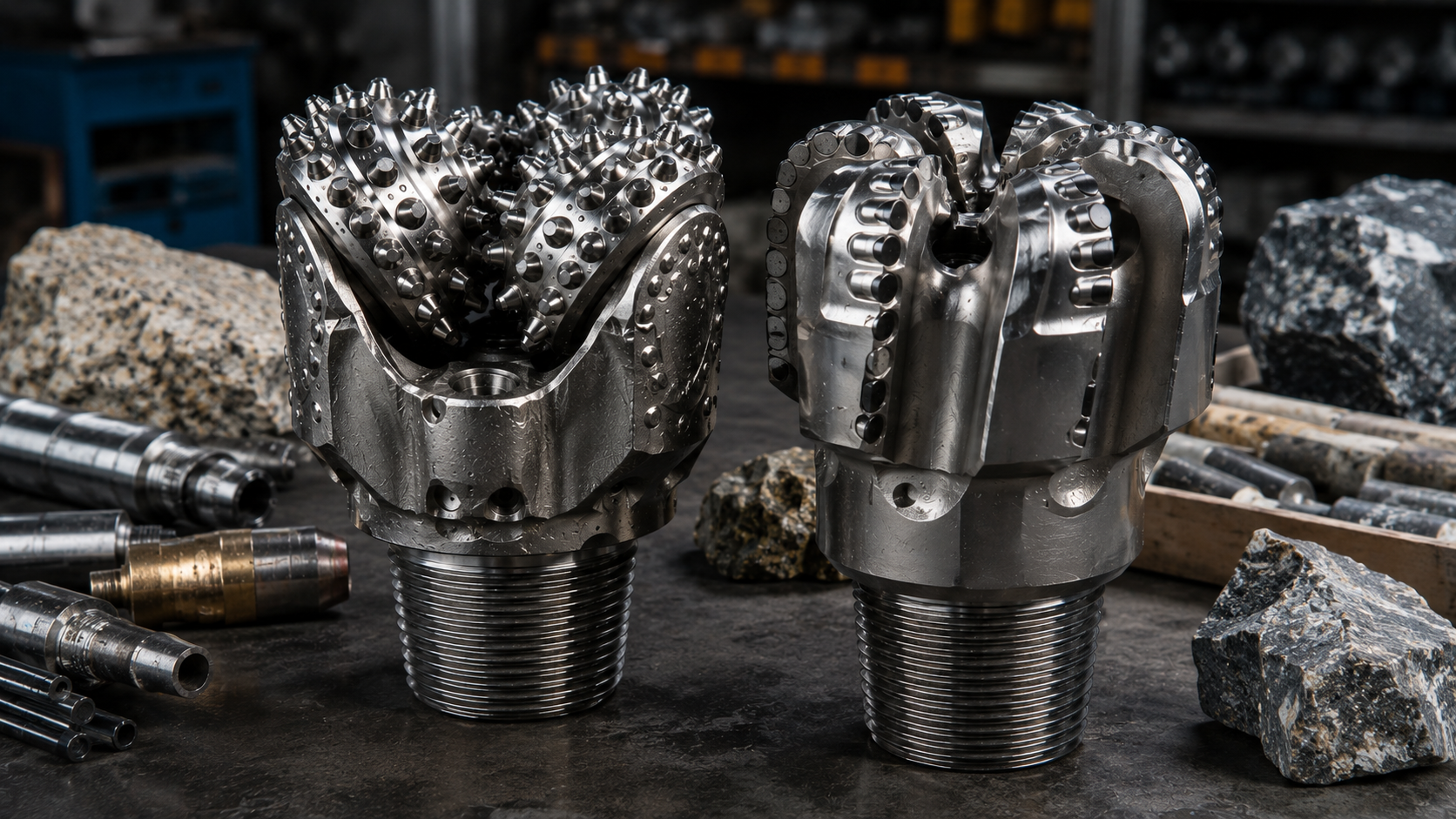
Choosing between a Tricone Bit and a PDC Bit is not simply a matter of comparing two different drill-bit shapes. The two technologies use fundamentally different rock-breaking mechanisms, which means their performance can change significantly depending on formation characteristics, drilling parameters, operating conditions and bit design.
For drilling contractors, mining engineers and purchasing teams, the more useful question is not which technology is universally better. The real question is which bit is better matched to the formation and drilling conditions of the specific project.
- What Is the Basic Difference Between a Tricone Bit and a PDC Bit?
- How Do Tricone and PDC Bits Break Rock Differently?
- Which Bit Performs Better in Soft, Medium and Hard Formations?
- How Do Drilling Speed, Bit Life and Operating Parameters Compare?
- What Are the Main Advantages and Limitations of Each Bit?
- How Should You Choose Between a Tricone Bit and a PDC Bit?
- How Does Cost per Meter Change the Decision?
- What Selection Checklist Should You Use Before Buying?
- FAQ About Tricone and PDC Bits
- Conclusion
1. What Is the Basic Difference Between a Tricone Bit and a PDC Bit?
One of the biggest mistakes in drilling-bit selection is treating Tricone Bits and PDC Bits as if they were simply two versions of the same drilling tool. Their cutting structures are fundamentally different, and that difference determines how they interact with rock.
| Feature | Tricone Bit | PDC Bit |
|---|---|---|
| Cutting structure | Three rotating cones with teeth or tungsten carbide inserts | Fixed blades with PDC cutters |
| Main rock-breaking mechanism | Crushing, chipping and indentation | Shearing and cutting |
| Moving cutting components | Rotating cones | Fixed cutting structure |
| Important wear areas | Teeth or inserts, gauge, bearings and seals | PDC cutters, blades and gauge |
| Major selection consideration | Formation hardness, abrasiveness, fractures and impact | Formation drillability, cutter design, profile and vibration |
This fundamental difference means that the selection process should begin with the formation instead of the name of the bit. The same drilling project can also require different bit technologies in different intervals.
2. How Do Tricone and PDC Bits Break Rock Differently?
The difference between crushing and shearing is not just a technical definition. It directly affects how drilling energy is transferred into the formation and how the bit responds to changing rock conditions.
How Does a Tricone Bit Break Rock?
A Tricone Bit contains three cones that rotate as the drill string turns. The teeth or tungsten carbide inserts contact the formation repeatedly, producing localized stresses that fracture and displace the rock.
Because the cones continuously roll across the bottom of the hole, the cutting action is based on repeated indentation, crushing and chipping. This makes roller-cone drilling particularly versatile when formation characteristics are not perfectly uniform.
How Does a PDC Bit Break Rock?
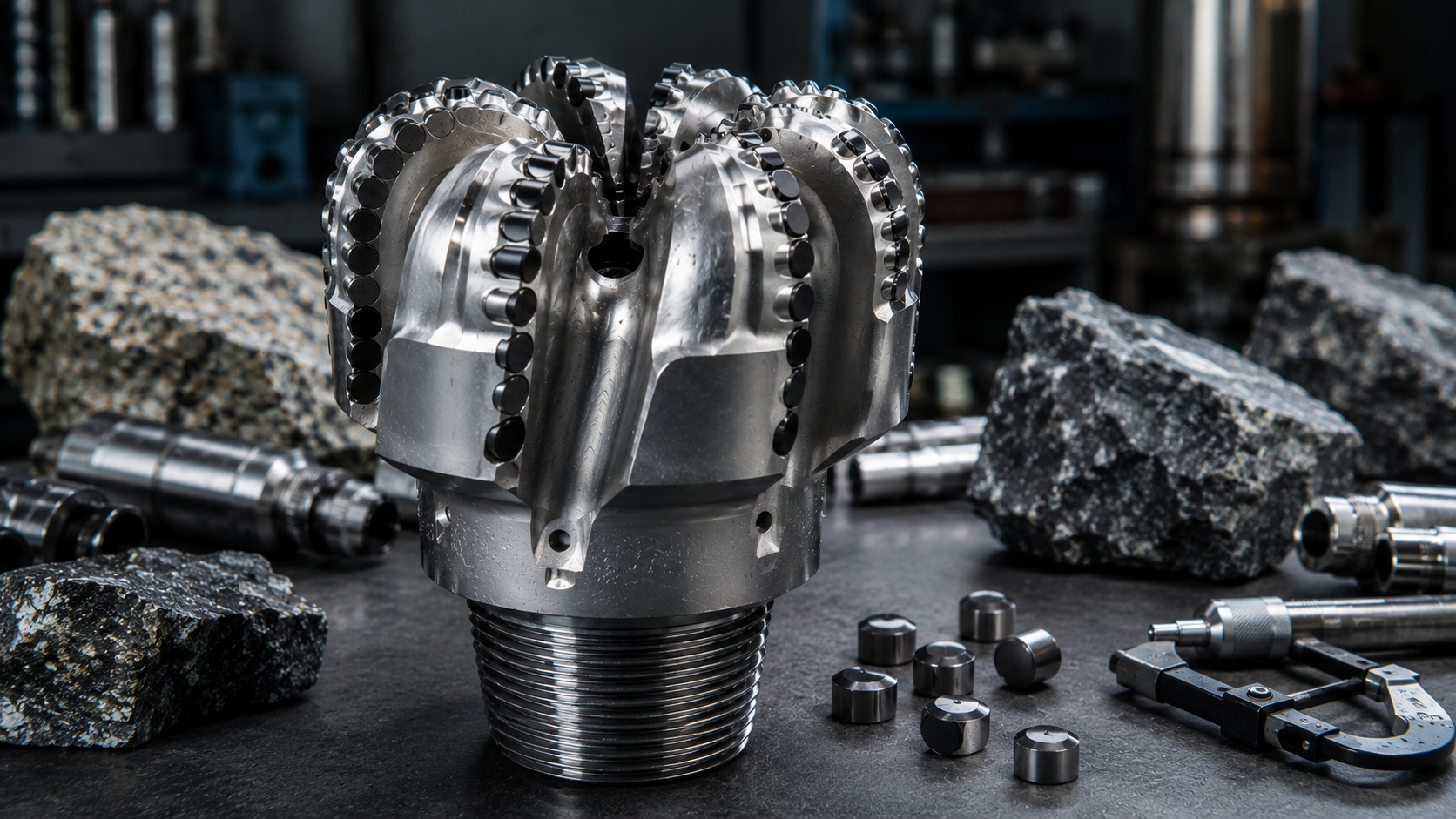
A PDC Bit uses polycrystalline diamond compact cutters mounted on fixed blades. As the bit rotates, the cutters scrape and shear the formation rather than using rolling cones.
When the rock responds well to shearing and the cutter loading is properly controlled, this mechanism can provide highly efficient continuous rock removal. However, cutter condition becomes particularly important when impact, vibration, abrasive wear or thermal loading increases.
| Rock-Breaking Characteristic | Tricone Bit | PDC Bit |
|---|---|---|
| Primary mechanism | Crushing and chipping | Shearing and cutting |
| Cutting elements | Teeth or carbide inserts on rotating cones | Fixed PDC cutters |
| Rock interaction | Repeated indentation and fracture | Continuous cutter engagement and shearing |
| Main sensitivity | Cone, tooth/insert, bearing and gauge condition | Cutter wear, impact, vibration and thermal loading |
This is why formation hardness alone is not enough to determine the correct bit. Abrasiveness, fracture intensity, bedding and lithology changes can also strongly influence the result.
3. Which Bit Performs Better in Soft, Medium and Hard Formations?
It is tempting to divide drilling applications into simple categories such as “soft rock equals PDC” and “hard rock equals Tricone.” In practice, the selection is more complicated. Formation uniformity, abrasiveness, impact potential and drilling objectives can all change the answer.
| Formation Condition | Tricone Bit Considerations | PDC Bit Considerations |
|---|---|---|
| Soft and relatively uniform | Can work effectively, depending on tooth and cone design | Often attractive when shearing remains stable |
| Medium-hard formation | Can be optimized through tooth and insert selection | Can provide efficient drilling with suitable cutter and profile design |
| Hard formation | TCI cutting structures can be selected for demanding rock | Requires careful cutter design and vibration control |
| Highly abrasive formation | Gauge protection and insert wear resistance become important | Cutter wear resistance becomes a major consideration |
| Fractured or variable formation | Mechanical versatility can be an important advantage | Impact and vibration can become more critical |
Why Does Formation Variability Matter?
Real drilling intervals are rarely perfectly uniform. A hole can move between competent rock, fractured zones, abrasive layers and different lithologies. Each change can alter the load experienced by the cutting structure.
A Tricone Bit can be attractive in mechanically variable ground because its rotating cones provide a different type of interaction with the rock.
A PDC Bit can be highly effective when the formation remains compatible with stable shearing and the cutter loading remains within an appropriate operating range.
Historical drilling records are therefore extremely useful. Previous bit footage, ROP and dull condition can often provide more practical selection information than a single rock-strength value.
4. How Do Drilling Speed, Bit Life and Operating Parameters Compare?
A drill bit does not work independently of the rig. Weight on bit, rotary speed, hydraulics and vibration all influence how effectively the available drilling energy is converted into penetration.
How Does WOB Affect Tricone Bits?
For a Tricone Bit, WOB affects how strongly the teeth or inserts engage the formation and contribute to the crushing and fracturing process.
The goal is to provide sufficient loading for effective rock breakage without creating unnecessary mechanical stress on the cones and other components.
How Does WOB Affect PDC Bits?
For a PDC Bit, WOB influences cutter engagement and depth of cut. The operating objective is to maintain productive cutter engagement while avoiding excessive loading, vibration or cutter damage.
Why Do RPM and Hydraulics Matter?
RPM changes the frequency and characteristics of cutting interaction. Hydraulics help remove drilled cuttings from the bottom of the hole and can also contribute to cooling and maintaining effective cutter engagement.
| Operating Variable | Tricone Bit | PDC Bit |
|---|---|---|
| WOB | Controls tooth/insert engagement and crushing action | Influences cutter depth of cut and cutting load |
| RPM | Affects cone rolling and bottom-hole contact | Affects cutter engagement frequency and frictional loading |
| Hydraulics | Support cooling and cuttings removal | Support cutter cooling and cuttings transport |
| Vibration | Can increase mechanical stress and wear | Can produce cutter impact and accelerated damage |
The appropriate operating window should always be established according to the specific bit design, drilling system and formation rather than copied directly from another application.
5. What Are the Main Advantages and Limitations of Each Bit?
Neither Tricone Bits nor PDC Bits are universally superior. Each technology offers advantages in certain drilling conditions and limitations in others.
What Are the Advantages of Tricone Bits?
The main advantage of a Tricone Bit is its mechanical versatility. Different tooth, insert and cone configurations can be designed for different formation conditions.
This makes roller-cone technology a useful option for applications involving hard, abrasive, fractured or variable formations where a more adaptable rock-breaking mechanism is desirable.
What Are the Limitations of Tricone Bits?
Roller-cone designs contain moving mechanical components. Bearing condition, seals, cone rotation and cutting-structure wear therefore become important factors in overall reliability.
Bit inspection after pulling is also important because tooth wear, gauge wear and mechanical condition can provide valuable information for the next bit selection.
What Are the Advantages of PDC Bits?
The major advantage of a PDC Bit is its fixed-cutter shearing mechanism. When the cutters, profile, hydraulics and formation are properly matched, the bit can remove formation efficiently through continuous shearing.
What Are the Limitations of PDC Bits?
PDC performance depends heavily on cutter condition. Excessive impact, vibration, thermal loading and abrasive wear can accelerate cutter damage and reduce drilling efficiency.
| Decision Factor | Tricone Bit | PDC Bit |
|---|---|---|
| Variable formation | Mechanical adaptability can be an advantage | Requires careful cutter and formation matching |
| Fractured formation | Rolling-cone mechanism can handle changing contact conditions | Impact and vibration control become particularly important |
| Continuous shearing | Not the primary mechanism | Major advantage when formation responds well to shearing |
| Moving mechanical components | Rotating cone assemblies are used | Fixed cutting structure |
| Primary wear concerns | Teeth/inserts, bearings, seals and gauge | PDC cutters, blades and gauge |
6. How Should You Choose Between a Tricone Bit and a PDC Bit?
The wrong bit selection can increase drilling cost even when the original purchase price looks attractive. Premature wear, low ROP, excessive vibration and additional trips can quickly offset a lower unit price.
Step 1: Analyze the Formation
Identify the expected lithology, hardness, abrasiveness, fracture intensity and degree of formation variability. Do not rely on a single geological parameter when the interval contains multiple formation types.
Step 2: Review Previous Bit Performance
Historical drilling data can reveal whether the formation caused cutter wear, cone wear, vibration, low ROP or premature failure.
For a Tricone Bit, review tooth or insert wear, gauge condition, cone condition and bearing-related symptoms. For a PDC Bit, review cutter wear, broken cutters, impact damage and other dull characteristics.
Step 3: Match the Cutting Structure
The decision should not stop at “Tricone” or “PDC.” The actual cutting structure must be selected according to the formation, expected wear mechanism and drilling objectives.
Step 4: Match WOB, RPM and Hydraulics
The drilling rig must be capable of providing an appropriate operating window. Available WOB, RPM, torque, flow rate and hydraulic pressure should therefore be reviewed before final bit selection.
Step 5: Compare the Complete Drilling Cycle
Finally, compare footage, ROP, expected bit life, trip frequency and drilling cost instead of looking only at purchase price.
Practical Selection Sequence
1. Formation and lithology
2. Hardness and abrasiveness
3. Fracture and impact potential
4. Previous drilling performance
5. Cutting-structure requirements
6. WOB / RPM / hydraulics
7. Expected bit life and footage
8. Cost per meter
7. How Does Cost per Meter Change the Decision?
Purchase price is easy to compare, but it is not enough to determine whether one bit is economically better than another. A more useful starting metric is direct bit cost per meter drilled.
Consider the following mathematical reference example. These figures are used only to demonstrate the calculation method and are not presented as field results or customer performance data.
| Reference Example | Bit A | Bit B |
|---|---|---|
| Purchase price | $2,000 | $2,600 |
| Footage drilled | 500 m | 800 m |
| Direct bit cost per meter | $4.00/m | $3.25/m |
In this mathematical example, Bit B has a purchase price that is 30% higher:
However, the calculated direct bit cost per meter is lower:
The example demonstrates an important principle: the most expensive bit to purchase is not necessarily the most expensive bit to operate.
Why Should ROP and Bit Life Be Evaluated Together?
Consider another mathematical reference example:
| Metric | Condition A | Condition B | Calculated Difference |
|---|---|---|---|
| ROP | 5 m/h | 7 m/h | 40% higher in B |
| Bit footage | 500 m | 800 m | 60% higher in B |
Reference calculation only. Actual drilling performance depends on formation, bit design, drilling rig, operating parameters, hydraulics and site conditions.
A complete drilling-cost analysis should eventually consider bit replacement frequency, trip time, rig utilization, labor, downtime and the economic consequences of premature bit failure.
8. What Selection Checklist Should You Use Before Buying?
Before purchasing a Tricone Bit or PDC Bit, the drilling team should confirm that enough technical information is available for a meaningful selection.
Formation
☐ What lithology is expected?
☐ How hard is the formation?
☐ How abrasive is the formation?
☐ Is the formation fractured or interbedded?
Drilling System
☐ What WOB range is available?
☐ What RPM range is available?
☐ What torque is available?
☐ What hydraulic flow and pressure are available?
Bit Design
☐ Is the cutting structure suitable for the formation?
☐ Is gauge protection important?
☐ What wear resistance is required?
Previous Bit Data
☐ What footage did the previous bit drill?
☐ What was the actual ROP?
☐ Why was the previous bit pulled?
☐ What was the actual dull condition?
Economics
☐ What is the direct cost per meter?
☐ How often may the bit require replacement?
☐ What is the impact of additional trips?
Why Should You Avoid Comparing Bits by Only One Specification?
Comparing two Tricone Bits only by price, or two PDC Bits only by cutter count, can produce a misleading conclusion.
A meaningful comparison should combine formation compatibility, cutting structure, operating window, wear behavior, drilling footage, ROP and total drilling economics.
This is also why professional bit selection should focus on the actual application rather than simply choosing the cheapest or most expensive available model.
9. FAQ About Tricone and PDC Bits
Is a Tricone Bit better than a PDC Bit?
Neither technology is universally better. A Tricone Bit can be advantageous in hard, abrasive, fractured or variable formations, while a PDC Bit can provide excellent efficiency when the formation is suitable for fixed-cutter shearing.
What is the main difference between Tricone Bits and PDC Bits?
The main difference is the rock-breaking mechanism. A Tricone Bit uses rotating cones and primarily crushes and chips the formation, while a PDC Bit uses fixed cutters and primarily shears the formation.
Can PDC Bits drill hard rock?
Yes. However, formation hardness alone does not determine whether a PDC Bit will be the best option. Abrasiveness, impact potential, vibration, cutter design, bit profile and operating conditions must also be considered.
When should I choose a Tricone Bit instead of a PDC Bit?
A Tricone Bit may be preferable when the formation is hard, abrasive, fractured or highly variable, particularly when mechanical adaptability is important. The actual selection should still be based on formation and drilling data.
How should I compare the cost of Tricone Bits and PDC Bits?
Start with direct cost per meter, then consider bit life, ROP, trip frequency, rig utilization, downtime and the wider drilling-cycle cost. Purchase price alone does not provide a complete economic comparison.
Can the same WOB and RPM be used for Tricone and PDC Bits?
No. Both technologies use WOB, RPM and hydraulics, but their cutting mechanisms are different. The appropriate operating window depends on the specific bit, drilling rig and formation.
10. Conclusion
The difference between a Tricone Bit and a PDC Bit is fundamentally a difference in rock-breaking technology. Roller-cone drilling uses rotating cones and crushing-based rock fragmentation, while PDC drilling uses fixed cutters and primarily relies on shearing.
Neither technology should be considered universally superior. The correct choice depends on formation hardness, abrasiveness, fracture characteristics, drilling objectives, cutting-structure design and operating conditions.
For professional drilling-bit selection, the most reliable approach is to combine geological information with historical drilling data, WOB, RPM, hydraulics, bit dull condition, footage, ROP and cost-per-meter analysis.
The goal is not simply to find the cheapest Tricone Bit or the most expensive PDC Bit. The goal is to select the drilling technology that provides the best overall result for the specific formation and drilling system.
Looking for the right drilling bit for your application?
Explore our Tricone Bits and PDC Bits, or CONTACT US with your formation information, drilling parameters and previous bit performance.