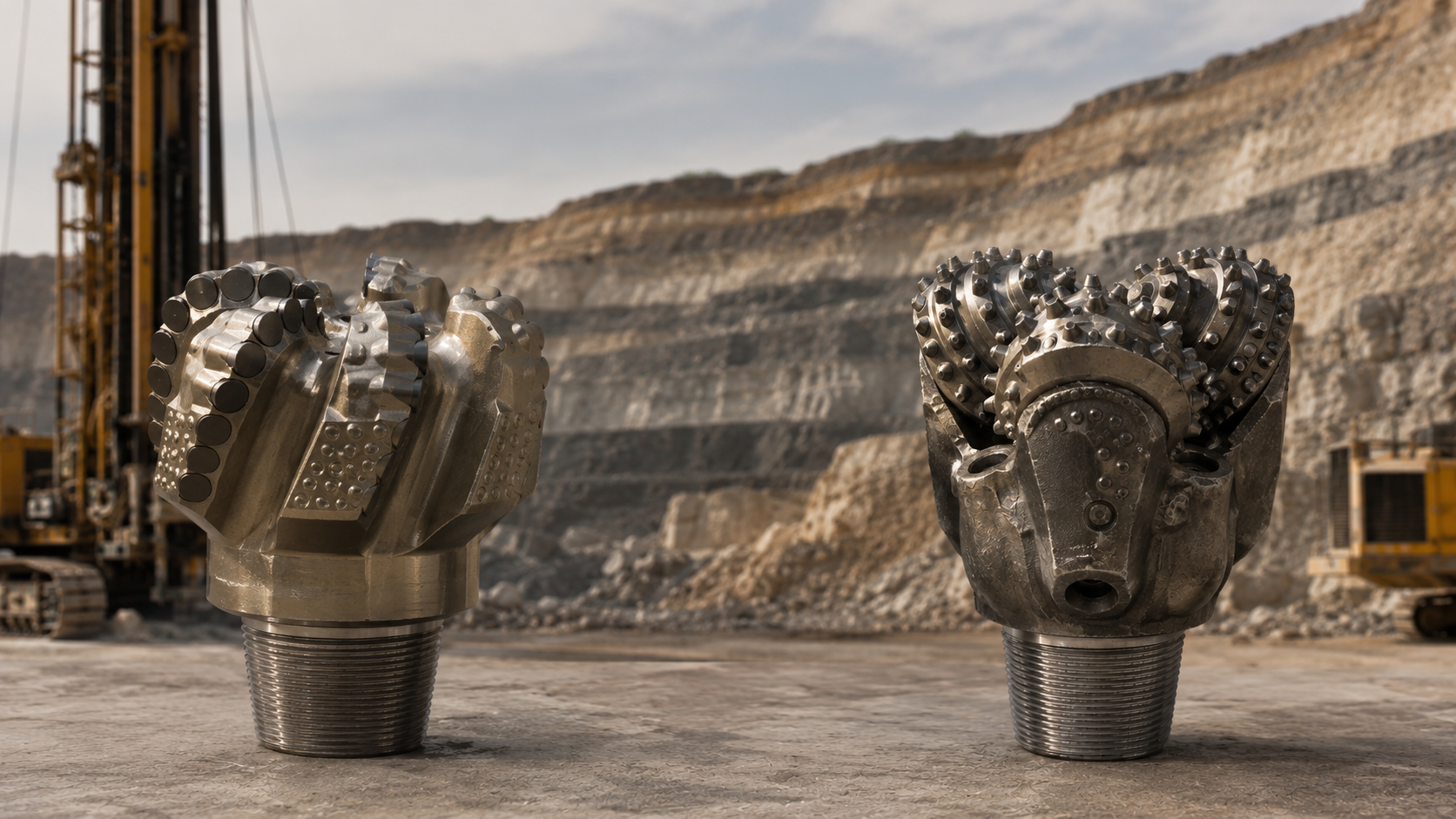
When choosing a drill bit for a new drilling project, one of the most important questions is often:
Should you use a PDC drill bit or a tricone drill bit?
There is no universal winner.
A PDC bit can deliver exceptionally high penetration rates and long runs in the right formation, while a tricone bit can provide greater versatility and impact tolerance in hard, fractured, abrasive, or highly variable formations.
The wrong choice, however, can increase bit wear, reduce ROP, cause premature failure, increase trip time, and raise the total cost of drilling.
The best drill bit is therefore not necessarily the most expensive or the newest technology.
The best drill bit is the one that matches the formation, drilling system, operating parameters, and project economics.
In this guide, we compare PDC drill bits and tricone drill bits from an engineering and purchasing perspective, including their rock-breaking mechanisms, formation suitability, ROP, bit life, drilling parameters, failure modes, and total cost.
PDC vs Tricone: The Short Answer
If you need a quick answer, use this general rule:
Choose a PDC bit when:
- The formation is relatively homogeneous.
- The rock is soft to medium-hard.
- Abrasiveness is manageable.
- High ROP is a priority.
- Long bit runs are important.
- Directional or horizontal drilling is required.
- Reducing trip frequency is important.
Choose a tricone bit when:
- The formation is hard or highly abrasive.
- The formation is fractured or interbedded.
- Rock properties change significantly during the interval.
- Impact resistance is more important than maximum ROP.
- The drilling environment is unpredictable.
- A TCI cutting structure is better suited to the formation.
This is only a starting point.
The final decision should be based on actual formation and drilling data.
What Is a PDC Drill Bit?
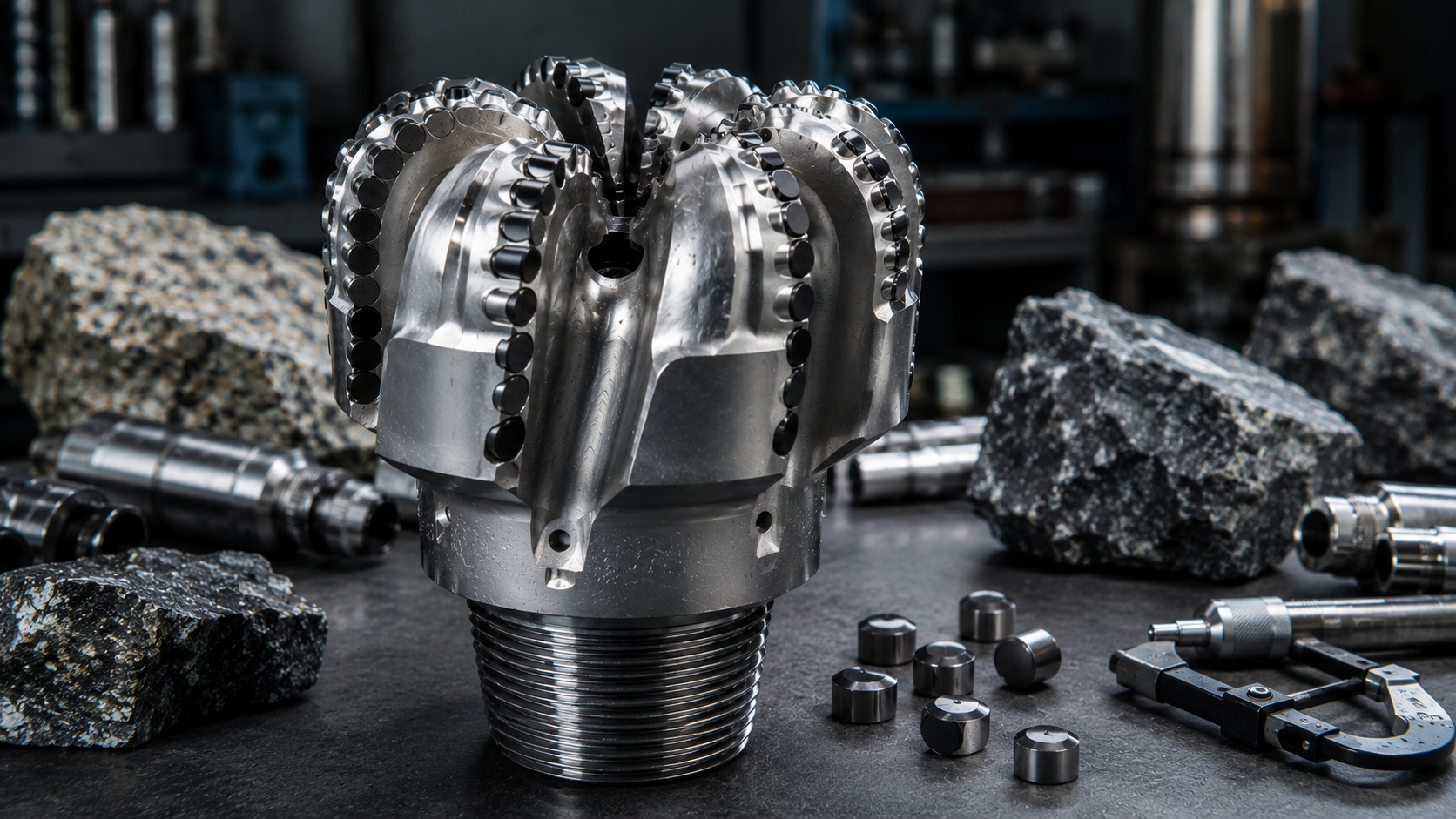
PDC stands for Polycrystalline Diamond Compact.
Unlike a tricone drill bit, a PDC bit does not use rotating cones.
Instead, it uses fixed diamond cutters mounted on blades or cutting structures.
As the drill string rotates, the cutters continuously contact the formation and remove rock primarily through a shearing action.
This fixed-cutter design means there are no cone bearings or moving cutting elements.
That provides an important advantage:
There are fewer mechanical components that can fail downhole.
PDC bits are widely used in applications where the formation is sufficiently compatible with fixed-cutter technology and where high drilling efficiency is required.
What Is a Tricone Drill Bit?
A tricone drill bit, also called a roller cone bit, uses three rotating cones.
The cones contain either:
- Milled teeth
- Tungsten carbide inserts
As the bit rotates, the cones roll across the formation.
The rock is broken through a combination of:
- Crushing
- Chipping
- Gouging
- Scraping
This mechanical rock-breaking mechanism gives tricone bits an important advantage in formations where impact resistance and adaptability are critical.
Tricone bits are available in a wide range of configurations, from soft-formation milled tooth designs to hard-formation TCI designs.
PDC vs Tricone: How Do They Break Rock?
The fundamental difference is the way each bit interacts with the formation.
PDC Bit: Shearing
PDC cutters scrape and shear the formation continuously.
Instead of repeatedly impacting the rock with individual teeth or inserts, the cutters create a continuous cutting action.
This can produce highly efficient drilling in formations with suitable mechanical properties.
The advantages can include:
- High ROP
- Smooth cutting action
- Efficient rock removal
- No moving cones
- Long runs in suitable formations
However, the fixed cutters can be vulnerable to severe impact loading.
If the formation suddenly becomes much harder or highly fractured, cutter damage can become a major concern.
Tricone Bit: Crushing and Chipping
A tricone bit uses three rotating cones to break the formation.
The cutting elements repeatedly contact the rock and create localized crushing and chipping.
This makes the tricone mechanism highly versatile.
The cones can tolerate formation changes that may create excessive impact loading on fixed PDC cutters.
This is one reason TCI tricone bits remain important for hard, abrasive, fractured, and variable formations.
PDC vs Tricone: Technical Comparison
| Factor | PDC Drill Bit | Tricone Drill Bit |
|---|---|---|
| Rock-breaking mechanism | Shearing | Crushing, chipping and gouging |
| Moving parts | None | Three rotating cones |
| Cutting elements | PDC diamond cutters | Milled teeth or TCI inserts |
| Typical ROP | High in suitable formations | Moderate to high depending on formation |
| Formation adaptability | Best in compatible, relatively consistent formations | Very broad formation adaptability |
| Hard fractured rock | Can be challenging | Often more tolerant |
| Abrasive formations | Cutter wear can be significant | TCI can provide strong wear resistance |
| Bearing failure risk | None | Present |
| Initial purchase cost | Often higher | Often lower |
| Trip frequency | Can be reduced with long runs | Depends on bit life and formation |
| Directional drilling | Very strong application | Application-dependent |
| Formation changes | More sensitive | Generally more tolerant |
| Primary performance advantage | High efficiency and ROP | Versatility and impact tolerance |
The table is a general comparison. Actual performance depends heavily on bit design and formation conditions.
Which Bit Is Better for Soft Rock?
Soft formations can be suitable for both PDC and tricone bits.
The key question is not simply whether the formation is soft.
You should also consider:
- Formation consistency
- Abrasiveness
- Rock strength
- Stickiness
- Bit balling risk
- Desired ROP
- Hydraulic cleaning
For a relatively consistent soft formation, a PDC bit can provide very efficient shearing and high penetration rates.
However, a milled tooth tricone can still be attractive where formation variability or operational simplicity is more important.
Example
Imagine drilling through a relatively uniform shale interval.
If the formation remains stable and the PDC bit can maintain efficient cutter engagement, PDC may provide a significant ROP advantage.
Now imagine a soft shale interval containing frequent hard limestone stringers.
The calculation changes.
The hard stringers can create impact loading and increase the risk of PDC cutter damage.
In that situation, a tricone may provide a more forgiving solution.
Formation consistency can therefore be just as important as formation hardness.
Which Bit Is Better for Hard Rock?
Hard rock requires more careful analysis.
The answer depends on:
- Rock compressive strength
- Abrasiveness
- Fracture intensity
- Formation homogeneity
- Impact loading
- Drilling parameters
- Bit design
TCI tricone bits have traditionally been an important option for hard and abrasive formations because tungsten carbide inserts can provide strong resistance to mechanical wear.
PDC technology has also expanded into harder formations, but the specific PDC design and cutter technology become increasingly important.
For highly fractured, impact-prone, or very abrasive formations, a tricone may provide greater operational tolerance.
The key point is:
“Hard rock” alone is not enough information to select the bit.
You need to understand what makes the rock difficult.
PDC vs TCI Tricone for Abrasive Formations
Abrasiveness deserves special attention.
A formation can be moderately hard but extremely abrasive.
Quartz-rich sandstone is a good example of why hardness and abrasiveness should not be treated as the same property.
For abrasive formations, evaluate:
- Cutter wear
- Insert wear
- Gauge wear
- Bit-body erosion
- Hydraulic cleaning
- Expected drilling interval
- Previous bit dull condition
A TCI tricone bit can be designed with wear-resistant inserts and gauge protection to handle demanding abrasive formations.
PDC bits may also be used successfully in certain abrasive formations when the cutter type, cutter density, body design, and operating parameters are appropriate.
Therefore, the question should not simply be:
“Is PDC good for abrasive rock?”
The better question is:
“Which specific bit design provides acceptable wear performance in this formation?”
PDC vs Tricone for Interbedded Formations
Interbedded formations are one of the most important situations to consider.
Suppose a drilling interval contains:
Soft shale → limestone → shale → sandstone → hard limestone
The bit is repeatedly exposed to changes in formation strength.
This can create:
- Shock loading
- Vibration
- Torque fluctuations
- Cutter impact
- Uneven wear
A PDC bit designed for a consistent formation may struggle when the formation changes rapidly.
A tricone bit can sometimes provide greater tolerance because its rotating cones distribute the rock-breaking process across multiple cutting structures.
This does not mean that tricone is always better for interbedded formations.
The actual decision depends on the severity and frequency of the formation transitions.
But if geological variability is high, formation adaptability should receive greater weight in the bit selection process.
PDC vs Tricone for Directional Drilling
Directional and horizontal drilling creates another important difference.
Directional drilling often benefits from:
- Predictable torque response
- Stable cutting
- Steerability
- Consistent bit behavior
- Reduced vibration
PDC bits are widely used in directional and horizontal drilling because their fixed cutting structure can provide controlled and continuous formation engagement.
However, tricone bits can also be used in directional applications depending on the drilling system and formation.
The correct choice depends on:
- Well trajectory
- BHA configuration
- Motor or RSS system
- Formation properties
- Required build rate
- Torque and vibration behavior
Therefore, directional drilling is a factor favoring PDC in many applications, but it should not be treated as an absolute rule.
Which Bit Has a Higher ROP?
In a compatible formation, PDC bits often have a significant ROP advantage.
The reason is simple:
PDC cutters continuously shear the formation rather than relying primarily on repeated crushing and chipping.
However, comparing theoretical ROP without considering formation and operating parameters can be misleading.
A PDC bit that is unsuitable for the formation may drill much more slowly than a properly selected tricone.
Therefore:
Bit design + formation + WOB + RPM + hydraulics = actual ROP
not:
PDC = always faster.
This distinction is extremely important when evaluating drilling performance.
Which Bit Has a Longer Life?
Again, there is no universal winner.
PDC bits have no moving cones or bearings, which eliminates one major mechanical failure mechanism.
However, PDC cutters can experience:
- Abrasion
- Chipping
- Fracturing
- Thermal damage
- Impact damage
Tricone bits have rotating cones and bearing systems.
Potential failure mechanisms include:
- Bearing wear
- Seal failure
- Cone damage
- Insert wear
- Tooth wear
- Gauge wear
Therefore, bit life depends on the formation and design.
A PDC bit may achieve an extremely long run in a stable formation.
A TCI tricone may outperform PDC in a hard, fractured, abrasive interval where cutter impact damage would otherwise dominate.
PDC vs Tricone: What About Cost?
This is where many buyers make a mistake.
They compare only the purchase price.
For example:
PDC bit price = $X
Tricone bit price = $Y
and conclude that the cheaper bit is more economical.
That calculation is incomplete.
The real drilling cost should consider:
- Bit purchase price
- ROP
- Bit footage
- Bit life
- Trip time
- Rig operating cost
- Replacement frequency
- Non-productive time
- Risk of downhole failure
A more useful concept is:
Cost per Foot or Cost per Meter
A simplified calculation is:
Cost per Foot = Total Bit-Related Drilling Cost ÷ Footage Drilled
For a more complete project analysis, include the rig cost associated with drilling time and trips.
A PDC bit may cost more initially but still produce a lower total drilling cost if it:
- Drills faster
- Drills farther per run
- Reduces trips
- Maintains stable performance
Conversely, a tricone may be more economical if a PDC experiences premature cutter damage.
The cheapest bit is not necessarily the lowest-cost bit.
A Practical PDC vs Tricone Decision Matrix
Use this as a preliminary selection framework:
| Drilling Condition | Preferred Starting Point |
|---|---|
| Soft, homogeneous shale | PDC |
| Soft, consistent sandstone | PDC |
| Medium homogeneous formation | PDC or TCI depending on properties |
| Medium limestone | TCI or PDC depending on abrasiveness and strength |
| Hard limestone | TCI tricone or specialized PDC |
| Highly abrasive sandstone | TCI tricone or formation-specific PDC |
| Highly fractured rock | TCI tricone often worth considering |
| Rapidly changing formations | Tricone often more forgiving |
| Directional/horizontal drilling | PDC often preferred |
| Very high ROP target | PDC when formation is compatible |
| Unknown formation | Tricone can provide a more conservative starting point |
| Severe impact environment | Tricone often provides greater tolerance |
This is a selection framework, not a universal specification.
Actual bit selection should be based on formation data and previous drilling performance.
8 Questions to Answer Before Choosing PDC or Tricone
Before ordering a drill bit, ask these eight questions.
1. What is the dominant rock type?
Is it shale, sandstone, limestone, dolomite, marl, or another formation?
2. How hard is the formation?
Determine rock strength rather than relying only on the geological name.
3. How abrasive is it?
Abrasiveness can dramatically change cutter and insert life.
4. Is the formation homogeneous?
Consistent formations are generally easier to optimize for fixed-cutter drilling.
5. How fractured is the formation?
Severe fractures can increase impact loading and vibration.
6. What ROP do you need?
If maximum ROP is critical, PDC may have a strong advantage in suitable formations.
7. How expensive is a trip?
The more expensive the trip, the more valuable a long bit run becomes.
8. What happened to the previous bit?
Previous bit performance is one of the most valuable sources of information for the next bit selection.
Use the Previous Bit to Choose the Next Bit
One of the best ways to improve drilling performance is to stop treating every bit run as an isolated event.
After pulling the bit, record:
- Bit type
- Bit size
- IADC code
- Formation
- Drilled footage
- Drilling hours
- Average ROP
- WOB
- RPM
- Torque
- Mud parameters
- Reason for pulling
- Dull condition
Then ask:
If the PDC bit failed early:
Was the problem:
- Cutter impact?
- Abrasion?
- Vibration?
- Formation change?
- Poor hydraulics?
- Excessive WOB?
- Excessive RPM?
If the tricone failed early:
Was the problem:
- Bearing failure?
- Seal failure?
- Insert wear?
- Cone damage?
- Gauge wear?
- Formation balling?
- Excessive vibration?
The answer can tell you whether you need to change:
Bit type → Bit design → IADC → Cutter configuration → Operating parameters
rather than simply buying another identical bit.
A Better Way to Select Between PDC and Tricone
Instead of asking:
“Which is better, PDC or tricone?”
ask:
“Which rock-breaking mechanism is better suited to my formation and drilling economics?”
This leads to a more professional selection process.
Step 1 — Analyze Formation
Determine:
Hardness + Abrasiveness + Fracturing + Homogeneity
Step 2 — Define the Drilling Objective
Determine whether the priority is:
ROP + Bit Life + Stability + Hole Quality + Cost per Foot
Step 3 — Evaluate Rig Capability
Consider:
- WOB capacity
- RPM range
- Torque
- Hydraulic capacity
- BHA
- Directional system
Step 4 — Select Bit Technology
Compare:
PDC vs TCI Tricone vs Milled Tooth Tricone
Step 5 — Select Detailed Bit Design
Then evaluate:
- Cutter or insert geometry
- Cutter density
- Cone design
- Bearing system
- Gauge protection
- Hydraulics
- Connection
Step 6 — Run and Record Performance
Measure:
- ROP
- Footage
- Bit hours
- Torque
- Vibration
- Wear
Step 7 — Optimize the Next Run
Use the results to refine the next bit.
This creates a continuous optimization cycle:
Formation Data → Bit Selection → Drilling → Dull Analysis → Performance Review → Improved Bit Selection
PDC vs Tricone: The Bottom Line
There is no single drill bit that is best for every formation.
Choose PDC when:
The formation is compatible with fixed-cutter drilling, relatively consistent, and high drilling efficiency is a priority.
PDC can offer:
- High ROP
- Long runs
- No bearing failure
- Excellent directional drilling performance
- Strong cost-per-foot potential
Choose Tricone when:
Formation variability, impact loading, hardness, abrasiveness, or operational uncertainty makes versatility more important.
Tricone bits can offer:
- Broad formation adaptability
- Strong impact tolerance
- TCI options for hard formations
- Milled tooth options for softer formations
- Proven performance across many drilling applications
The most important lesson is:
PDC and tricone bits are not simply competing products. They are different rock-breaking technologies designed to solve different drilling problems.
The right selection depends on the formation, drilling parameters, equipment, and economics of the project.
Frequently Asked Questions
Is a PDC bit better than a tricone bit?
Not universally. PDC bits can outperform tricone bits in suitable soft-to-medium, relatively consistent formations, while tricone bits can be more suitable for hard, abrasive, fractured, or variable formations.
Is PDC or tricone better for hard rock?
It depends on rock strength, abrasiveness, fracturing, and the specific bit design. TCI tricone bits are commonly considered for hard and abrasive formations, while specialized PDC designs can also perform in selected hard-rock applications.
Which bit gives higher ROP?
PDC bits often provide higher ROP in formations where fixed-cutter shearing is effective. However, an unsuitable PDC bit can perform worse than a properly selected tricone.
Which bit lasts longer?
There is no universal answer. PDC bits have no moving bearings, while tricone bit life can be limited by bearing and seal performance. PDC cutters can suffer impact and abrasive damage, while TCI tricone bits can provide strong durability in appropriate hard formations.
Is a PDC bit more expensive than a tricone?
PDC bits often have a higher initial purchase price. However, the total drilling cost can be lower when the PDC delivers higher ROP and longer runs.
What is better for directional drilling?
PDC bits are widely used for directional and horizontal drilling because their fixed-cutter design can provide predictable cutting behavior and good steerability. The final choice still depends on the BHA and formation.
What should I consider when choosing between PDC and tricone?
At minimum, evaluate formation hardness, abrasiveness, fracturing, homogeneity, desired ROP, drilling depth, WOB, RPM, hydraulic conditions, trip cost, and previous bit performance.
Can a PDC bit replace a tricone bit?
Sometimes, but not universally. A PDC can replace a tricone when the formation and drilling system are suitable. In hard, fractured, highly abrasive, or rapidly changing formations, a tricone may remain the more appropriate choice.
Final Thoughts
Choosing between a PDC drill bit and a tricone drill bit should be treated as an engineering decision rather than a simple product comparison.
The correct choice comes down to five major factors:
Formation → Bit Technology → Drilling Parameters → Bit Life → Total Cost
If the formation is predictable and compatible with PDC technology, the higher ROP and long-run potential of a PDC bit can provide significant economic advantages.
If the formation is hard, fractured, abrasive, or highly variable, a TCI tricone may provide the durability and formation tolerance required to complete the interval efficiently.
For drilling contractors and international buyers, the most reliable approach is to provide the drill bit manufacturer with actual formation and previous run data rather than requesting a bit based only on diameter.
At Lilin Bit, we supply PDC drill bits and tricone drill bits for different drilling conditions and applications. By evaluating formation characteristics, drilling parameters, previous bit performance, and project objectives, we can help customers determine which bit technology is more appropriate for their specific operation.
Not sure whether your project requires a PDC or tricone drill bit? Send us your bit size, formation type, previous bit performance, WOB, RPM, and drilling application. Our technical team can help you compare the available options and identify a suitable drilling solution.