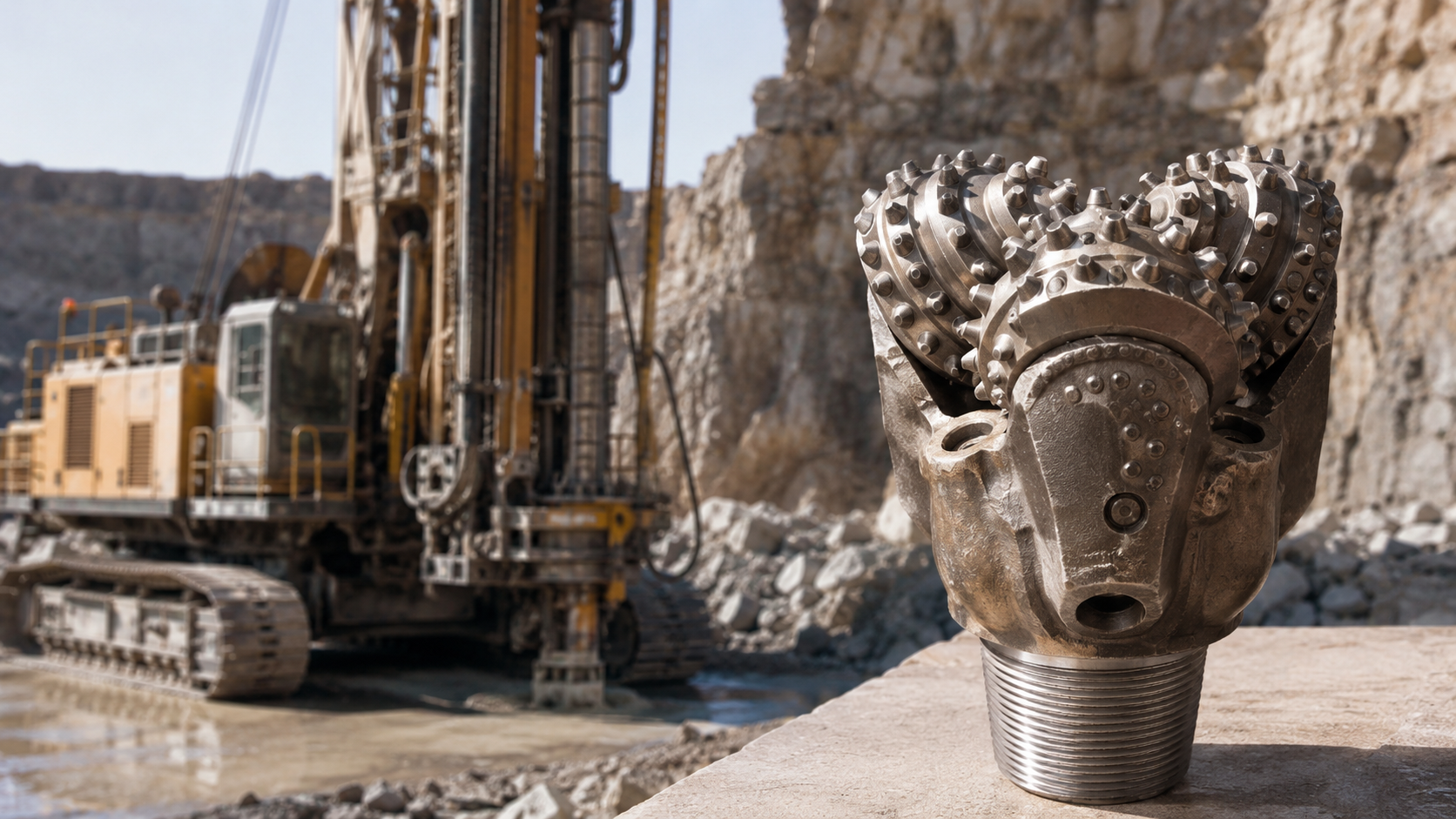
Choosing the right tricone drill bit is one of the most important decisions in rotary drilling. The wrong bit can lead to low penetration rates, excessive wear, poor hole quality, premature bearing failure, and unnecessary drilling costs.
A tricone drill bit should not be selected simply by size or price. The most important factors include rock formation, compressive strength, abrasiveness, drillability, bit structure, IADC classification, WOB, RPM, and drilling conditions.
Whether you are drilling for oil and gas, water wells, mining, geothermal projects, construction, or other rock drilling applications, understanding how formation characteristics affect tricone bit selection can significantly improve drilling performance.
In this guide, we explain how to select the right tricone drill bit for different rock formations and what drilling engineers and buyers should consider before placing an order.
What Is a Tricone Drill Bit?
A tricone drill bit, also known as a roller cone drill bit, is a rotary drilling tool consisting of three rotating cones mounted on the bit body.
Each cone contains cutting elements designed to break the formation through a combination of crushing, chipping, and scraping.
Tricone bits are commonly used in formations ranging from relatively soft clay and shale to hard sandstone, limestone, dolomite, and other challenging rock formations.
The two main types of tricone bits are:
- Milled tooth tricone bits – generally used for softer to medium formations.
- TCI tricone bits – equipped with tungsten carbide inserts and commonly used for medium to hard and abrasive formations.
The correct choice depends heavily on the formation being drilled.
Why Rock Formation Matters When Selecting a Tricone Bit
Different rock formations require different cutting structures.
A bit designed for soft shale may not perform well in hard limestone. Likewise, using an extremely aggressive bit in a soft formation can result in inefficient drilling, excessive vibration, or unnecessary wear.
Before selecting a tricone drill bit, consider the following formation characteristics:
1. Rock Hardness
Rock hardness is one of the most important factors in bit selection.
Soft formations generally require a more aggressive cutting structure that can penetrate the formation efficiently.
Hard formations require stronger cutting elements and a bit structure capable of handling higher loads.
Typical formation considerations include:
- Soft shale
- Clay
- Marl
- Medium sandstone
- Limestone
- Dolomite
- Hard sandstone
- Hard shale
- Highly consolidated formations
The harder the formation, the more important insert strength, cone design, bearing performance, and bit durability become.
2. Formation Abrasiveness
Two formations can have similar hardness but very different abrasiveness.
Abrasive formations can rapidly wear down cutting elements and bit gauge surfaces.
Sandstone, for example, may contain highly abrasive particles that accelerate wear.
For abrasive formations, drillers often require:
- Wear-resistant tungsten carbide inserts
- Strong gauge protection
- Appropriate insert geometry
- Durable bearing systems
- Proper hydraulic cleaning
Ignoring abrasiveness can result in premature bit failure even when the selected bit appears suitable for the formation hardness.
3. Formation Homogeneity
Is the formation relatively uniform, or are multiple rock types encountered during drilling?
A homogeneous formation is generally easier to match with a specific cutting structure.
Interbedded formations can be more challenging because the bit may repeatedly transition between soft and hard layers.
These changes can increase:
- Vibration
- Shock loading
- Insert damage
- Cone wear
- Bearing stress
For highly variable formations, bit selection should consider the complete drilling interval rather than focusing on only one rock type.
Tricone Bit Selection by Rock Formation
The following guide provides a general starting point for selecting a tricone drill bit.
| Rock Formation | Typical Bit Type | Important Considerations |
|---|---|---|
| Soft shale | Milled tooth or soft-formation TCI | High cutting aggressiveness and good cleaning |
| Clay | Soft-formation tricone | Reduce bit balling and improve hydraulics |
| Marl | Soft to medium formation bit | Balance aggressiveness and durability |
| Medium sandstone | Medium-formation TCI | Wear resistance and effective gauge protection |
| Limestone | Medium to hard TCI | Strong inserts and stable drilling |
| Dolomite | Hard-formation TCI | High insert strength and bearing durability |
| Hard sandstone | Hard-formation TCI | Abrasion resistance and gauge protection |
| Hard shale | Medium-hard or hard TCI | Control vibration and optimize WOB/RPM |
| Highly abrasive formation | Wear-resistant TCI | Insert durability and gauge protection |
This table should be treated as a general selection guide rather than a substitute for formation-specific drilling data.
Actual bit performance depends on formation properties, drilling parameters, hydraulic conditions, and bit design.
How to Choose a Tricone Bit for Soft Formations
Soft formations typically require a highly aggressive cutting structure.
Examples include:
- Soft shale
- Clay
- Marl
- Soft limestone
- Unconsolidated formations
For these formations, a tricone bit should provide efficient formation penetration while maintaining good bottom-hole cleaning.
Key characteristics to consider
A suitable bit may feature:
- Aggressive tooth or insert geometry
- Wider spacing between cutting elements
- Efficient formation removal
- Good hydraulic cleaning
- Appropriate cone offset
- Protection against formation balling
One of the most common problems when drilling soft, sticky formations is bit balling.
When formation material accumulates between the cutting elements, the bit may lose its ability to effectively contact and penetrate the bottom of the hole.
This can cause ROP to decrease dramatically.
Therefore, bit design and hydraulic performance should be evaluated together.
How to Choose a Tricone Bit for Medium Formations
Medium formations often require a balance between aggressiveness and durability.
Typical examples include:
- Medium sandstone
- Medium shale
- Limestone
- Marlstone
- Moderately consolidated formations
For these applications, TCI tricone bits are commonly considered because tungsten carbide inserts provide greater resistance to wear than conventional milled teeth in many drilling conditions.
The ideal bit should provide enough cutting aggressiveness to maintain ROP while resisting premature insert and gauge wear.
For medium formations, pay particular attention to:
- Insert shape
- Insert spacing
- Cone design
- Bearing system
- Gauge protection
- Hydraulic configuration
The objective is not simply to maximize initial ROP. A better objective is to achieve a strong balance between ROP, bit life, and cost per foot.
How to Choose a Tricone Bit for Hard Rock
Hard formations place significantly greater mechanical demands on a drill bit.
Typical examples include:
- Hard limestone
- Dolomite
- Hard sandstone
- Dense formations
- Highly consolidated rock
For hard rock drilling, a durable TCI tricone bit is generally more appropriate than a bit designed primarily for soft formations.
Important considerations include:
Strong Tungsten Carbide Inserts
Hard formations can generate significant impact forces.
The insert material, geometry, placement, and retention must therefore be suitable for the expected formation.
Durable Bearing System
Hard formations often require higher mechanical loads.
A reliable bearing and sealing system can help maintain cone rotation under demanding drilling conditions.
Gauge Protection
Gauge wear can reduce hole diameter and affect overall drilling performance.
Appropriate gauge protection is particularly important when drilling abrasive hard rock.
Stable Cutting Structure
Excessive aggressiveness can increase vibration and insert damage.
For hard formations, the objective is to achieve controlled rock breaking rather than simply maximizing aggressiveness.
TCI Tricone Bit vs Milled Tooth Tricone Bit
One of the most common questions when selecting a tricone drill bit is whether to use a TCI bit or a milled tooth bit.
Milled Tooth Tricone Bits
Milled tooth bits use steel teeth machined directly from the cone material.
They are commonly used in softer formations where aggressive cutting action is required.
Advantages can include:
- High cutting aggressiveness
- Effective penetration in softer formations
- Suitable for certain shale and clay formations
- Simple and effective cutting structure
However, tooth wear can become a significant concern in highly abrasive formations.
TCI Tricone Bits
TCI bits use tungsten carbide inserts mounted into the cones.
They are commonly selected for medium, hard, and abrasive formations.
Advantages include:
- High wear resistance
- Suitable for harder rock
- Stronger resistance to abrasive formations
- Wide range of insert geometries
- Flexible cutting structure design
The best choice depends on the formation rather than simply the bit type.
Understanding IADC Codes Before Selecting a Tricone Bit
IADC classification is another important part of tricone bit selection.
An IADC code provides information about the bit’s intended formation range and cutting structure.
For buyers and drilling engineers, understanding IADC classification can make it easier to compare different tricone drill bits and communicate drilling requirements with manufacturers.
However, an IADC code should not be considered the only factor in bit selection.
Two bits with similar IADC classifications may still have different:
- Insert configurations
- Cone designs
- Bearing systems
- Gauge protection
- Hydraulic configurations
- Manufacturing specifications
Therefore, IADC classification should be evaluated together with actual formation and drilling data.
For a detailed explanation, see our guide:
IADC Bit Classification Explained: How to Select the Right Tricone Bit
How WOB and RPM Affect Tricone Bit Selection
Bit selection and drilling parameters are closely connected.
Two important parameters are:
WOB – Weight on Bit
RPM – Revolutions Per Minute
A bit that performs well under one combination of WOB and RPM may not perform the same way under another.
Excessive WOB
Too much weight on the bit can increase:
- Insert damage
- Cone stress
- Bearing load
- Vibration
- Uneven wear
Excessive RPM
Excessive rotational speed can increase:
- Cutting element wear
- Vibration
- Heat generation
- Cone and bearing stress
The ideal WOB and RPM depend on the formation, bit design, drilling equipment, hole size, and operating conditions.
This is why bit selection should always be considered as part of the complete drilling system.
How to Select the Right Tricone Bit Size
Bit diameter is obviously critical, but choosing the correct size involves more than matching the required hole diameter.
Before ordering a tricone drill bit, confirm:
- Required hole diameter
- API connection
- Pin size
- Nozzle configuration
- Gauge requirements
- Drilling depth
- Rig specifications
- Formation characteristics
- Expected WOB and RPM
For international buyers, providing accurate technical specifications to the drill bit manufacturer can significantly reduce the risk of receiving an unsuitable product.
7 Questions to Ask Before Buying a Tricone Drill Bit
Before purchasing a tricone bit, answer these questions:
1. What formation are you drilling?
Identify the main rock type and formation hardness.
2. How abrasive is the formation?
High abrasiveness requires additional attention to insert and gauge wear.
3. What is your required hole diameter?
Confirm the exact bit size and gauge requirements.
4. What WOB and RPM will be used?
The bit should be compatible with your planned drilling parameters.
5. Are you using TCI or milled tooth?
Choose based on formation rather than price alone.
6. What is your API connection?
The bit must match the drilling equipment and connection specification.
7. What is your main performance target?
Do you prioritize:
- Higher ROP?
- Longer bit life?
- Lower cost per foot?
- Better gauge retention?
- More stable drilling?
The answer can change the ideal bit design.
How the Right Tricone Bit Can Reduce Drilling Costs
The cheapest drill bit is not always the lowest-cost drilling solution.
A better way to evaluate a drill bit is to consider the total drilling cost.
Important factors include:
Bit purchase price + drilling time + trip time + bit life + ROP + replacement cost
For example, a low-cost bit that drills slowly and requires an early trip out of the hole may cost significantly more than a higher-performance bit.
This is why professional drill bit selection should focus on cost per foot or cost per meter, rather than purchase price alone.
A properly selected tricone bit can help:
- Improve penetration rate
- Extend bit life
- Reduce unnecessary trips
- Maintain hole gauge
- Improve drilling consistency
- Reduce overall drilling cost
Common Mistakes When Selecting a Tricone Drill Bit
Choosing Based Only on Price
Price is important, but it should not be the only selection criterion.
A cheaper bit may have a shorter working life or lower ROP.
Choosing Only by Bit Size
Correct diameter does not guarantee correct formation performance.
Ignoring Formation Abrasiveness
Hardness and abrasiveness are not the same thing.
A relatively moderate formation can still cause severe wear if it is highly abrasive.
Ignoring Drilling Parameters
A bit should be matched to the actual WOB, RPM, hydraulic conditions, and rig capability.
Selecting an IADC Code Without Understanding the Formation
IADC classification is useful, but actual formation conditions must still be considered.
What Information Should You Give a Drill Bit Manufacturer?
If you want a manufacturer to recommend the most suitable tricone drill bit, provide as much drilling information as possible.
A useful request should include:
- Bit diameter
- Formation type
- Formation hardness
- Formation abrasiveness
- Previous bit type
- Previous IADC code
- Previous bit performance
- Drilling depth
- WOB
- RPM
- Mud or drilling fluid information
- Hydraulic conditions
- API connection
- Target ROP
- Expected bit life
The more accurate the information, the easier it is for a professional drill bit manufacturer to recommend the appropriate cutting structure and configuration.
Frequently Asked Questions
What type of tricone bit is best for hard rock?
TCI tricone bits are commonly used for hard and abrasive formations because tungsten carbide inserts provide strong wear resistance. However, the exact insert geometry and bit design should be matched to the specific formation.
What type of tricone bit is best for soft shale?
Soft-formation tricone bits with an aggressive cutting structure are often suitable for soft shale. Hydraulic cleaning is also important to reduce the risk of bit balling.
Are TCI bits better than milled tooth bits?
Neither is universally better. TCI bits are generally more suitable for medium to hard and abrasive formations, while milled tooth bits can be highly effective in softer formations.
How do I choose an IADC tricone bit?
Start with the formation hardness and abrasiveness, then consider the IADC classification, cutting structure, bearing design, gauge protection, and drilling parameters.
What information does a drill bit manufacturer need?
At minimum, provide the bit size, formation type, drilling application, API connection, and previous bit performance. WOB, RPM, depth, hydraulic conditions, and previous IADC information are also valuable.
How can I improve tricone bit life?
Use the correct bit for the formation, maintain suitable WOB and RPM, control vibration, maintain effective bottom-hole cleaning, and monitor bit wear during drilling.
Final Thoughts
Choosing the right tricone drill bit is ultimately a formation-matching problem.
The best bit is not necessarily the most aggressive, the most expensive, or the cheapest. It is the bit that provides the right balance between ROP, durability, hole quality, bit life, and total drilling cost for the specific formation and drilling conditions.
Before purchasing a tricone drill bit, evaluate:
Formation → Hardness → Abrasiveness → Bit Type → IADC Classification → WOB/RPM → Hydraulics → Expected Bit Life
For drilling contractors, mining companies, water well contractors, geothermal drilling companies, and international drill bit distributors, working with an experienced manufacturer can make the selection process significantly easier.
At Lilin Bit, we focus on manufacturing and supplying professional drilling tools for different rock formations and drilling applications. By combining formation information with actual drilling requirements, customers can select a tricone drill bit configuration that better matches their project conditions.
Need help selecting the right tricone drill bit for your formation? Contact Lilin Bit with your bit size, formation type, IADC code, WOB, RPM, and previous drilling performance. Our team can help you evaluate the appropriate bit configuration for your application.
Suggested SEO Information
SEO Title:
How to Choose the Right Tricone Drill Bit for Different Rock Formations
Meta Description:
Learn how to choose the right tricone drill bit for soft, medium, hard, and abrasive rock formations. Compare TCI and milled tooth bits, IADC codes, WOB, RPM, and bit selection factors.
Primary Keyword:
tricone drill bit
Secondary Keywords:
tricone drill bit selection, how to choose a tricone drill bit, tricone bit for hard rock, tricone bit for soft formation, TCI tricone bit, milled tooth tricone bit, IADC tricone bit, rock formation drill bit, tricone bit manufacturer
Suggested URL Slug:/how-to-choose-the-right-tricone-drill-bit/
Suggested Internal Links:
- IADC Bit Classification
- Tricone Drill Bits
- PDC Drill Bits
- Drill Bit Failure Analysis
- Contact / Request a Quote